Published
7 minute read
If you're researching a hair transplant, you've probably come across a lot of terminology: FUE, FUT, manual extraction, robotic transplantation and ARTAS.
Patients often ask me which technique is “best.”
I think that's the wrong first question.
What matters more is:
Why are you losing your hair? Is the loss stable? How much donor hair do you have? And what will still look natural years from now?
Once we understand that, we can decide how best to harvest the grafts.
At FORM Face + Body in Toronto, we focus on follicular unit excision, or FUE, using both manual FUE and ARTAS robotic FUE.
We don't routinely perform FUT, or strip surgery.
With Follicular Unit Extraction (FUE), individual follicular units are removed from the donor area, usually at the back and sides of the scalp, and transplanted into areas where more hair is needed.
Unlike FUT, FUE does not require removal of a strip of scalp. [1]
But FUE is only the harvesting method.
A natural result still depends on decisions such as:
The technology removes the grafts. The plan determines the result.
FUT, or follicular unit transplantation, involves removing a strip of hair-bearing scalp from the back of the head and closing the incision. That leaves a linear scar.
FUT can produce excellent grafts, and I don't consider it a bad technique. [2]
Our preference for FUE is mainly about the donor area.
FUE replaces one long linear scar with many tiny, dispersed extraction sites. That can make it easier for patients to wear their hair shorter without exposing a strip scar.
There is one important clarification:
FUE is not scar-free.
Every incision heals with some degree of scarring. FUE simply creates a different pattern of scars: small, scattered sites rather than one continuous line.
For most of our patients, that is a trade-off we prefer.
With manual FUE, the harvesting instrument is controlled directly by the operator.
That allows continual adjustment for differences in:
Hair follicles don't all grow in exactly the same way, so manual FUE gives us flexibility.
That's why I don't see manual FUE as outdated.
It remains an important part of our program.
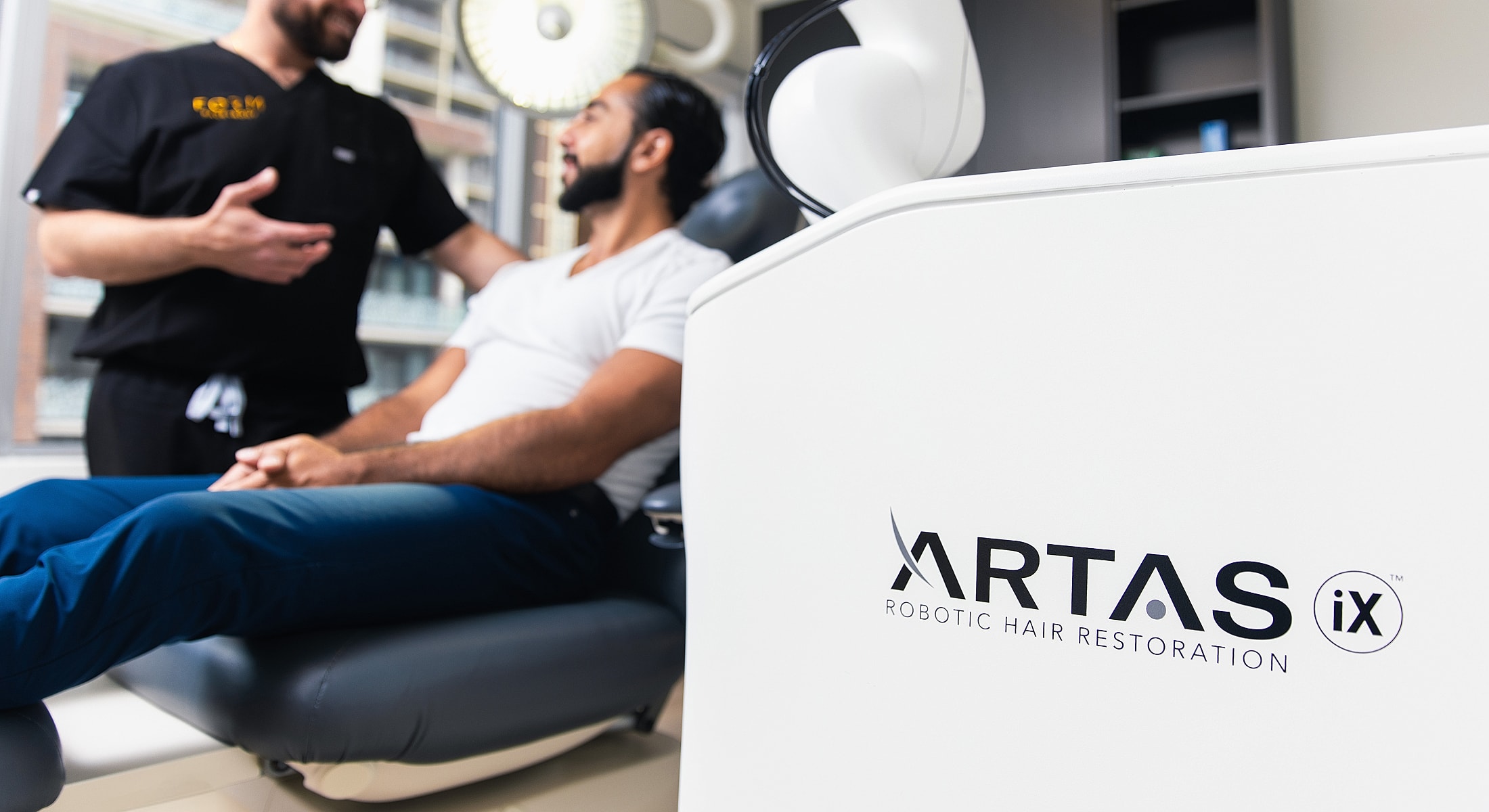
ARTAS is also FUE.
The difference is that the system uses artificial intelligence, digital imaging and robotic guidance to help identify and harvest follicular units.
It can analyze the donor area and assist with some of the repetitive work involved in extracting hundreds or thousands of grafts. [3]
What ARTAS does not do is decide:
Those decisions still require medical and aesthetic judgment.
Not for every patient, and I would not tell a patient that a robot automatically produces a better hair transplant.
What excites me about ARTAS is where the technology is going.
Hair transplantation involves a large amount of repetitive, precision work. Manual extraction can require thousands of nearly identical movements, and operator fatigue can affect performance during long procedures. [4]
Robotics offers the ability to combine imaging, automation and increasingly sophisticated software with that repetitive part of the procedure.
That is why I believe robotics will play an increasingly important role in the future of hair restoration.
But I don't think the future is the robot replacing the surgeon.
I think it's the surgeon using better technology.
Because not every patient is the same.
Some donor areas are particularly well suited to robotic harvesting.
Other patients may be better treated manually because of hair curl, growth pattern, scalp characteristics or other anatomical factors.
Having both options means I don't have to force every patient into the same technique.
The question isn't whether the robot or the human hand is better.
The question is which tool makes the most sense for your donor area and your long-term plan.
In many ways, yes.
Patients often focus on FUE versus ARTAS because that's what they see in advertising.
But after the transplant, nobody looking at you knows how the follicles were extracted.
They see the hairline.
A natural hairline depends on:
A perfectly harvested graft placed into a poorly designed hairline is still part of a poor transplant.
That's why my philosophy is:
Technology is a tool. The plan is the treatment.
This is just as important as choosing the transplant technique.
A hair transplant redistributes donor hair.
It does not stop your existing hair from continuing to thin.
Current reviews emphasize medical optimization and long-term donor planning before transplantation. [1,5]
Depending on the patient, that may include treatments such as a DHT blocker, minoxidil or other medical therapies.
This becomes particularly important in younger patients.
Your donor supply is finite. A graft we use today is a graft we can't use again 15 years from now.
Start with the plan, not the machine.
At FORM, I think about hair transplantation in four steps.
First, diagnose and stabilize the hair loss where possible.
Second, assess the donor area and think about the hair you may lose in the future.
Third, design a hairline that looks natural today and continues to make sense as you age.
Fourth, choose the harvesting method that best fits you.
For most of our patients, that means choosing between manual FUE and ARTAS robotic FUE.
We generally don't perform FUT because we prefer to avoid creating a linear donor scar when FUE can achieve the result we need.
And while I'm enthusiastic about where robotic hair transplantation is heading, I don't believe technology replaces experience or judgment.
The future of hair restoration, in my view, is the combination of both:
A thoughtful surgeon making the plan, supported by increasingly precise technology to help execute it.
That's how we approach hair restoration at FORM Face + Body in Toronto.
A medical assessment is required to determine the cause of hair loss, transplant candidacy and the most appropriate harvesting technique. All hair-transplant techniques create some degree of donor-site healing and scarring. This article is educational and is not a substitute for individual medical assessment.
References
written by
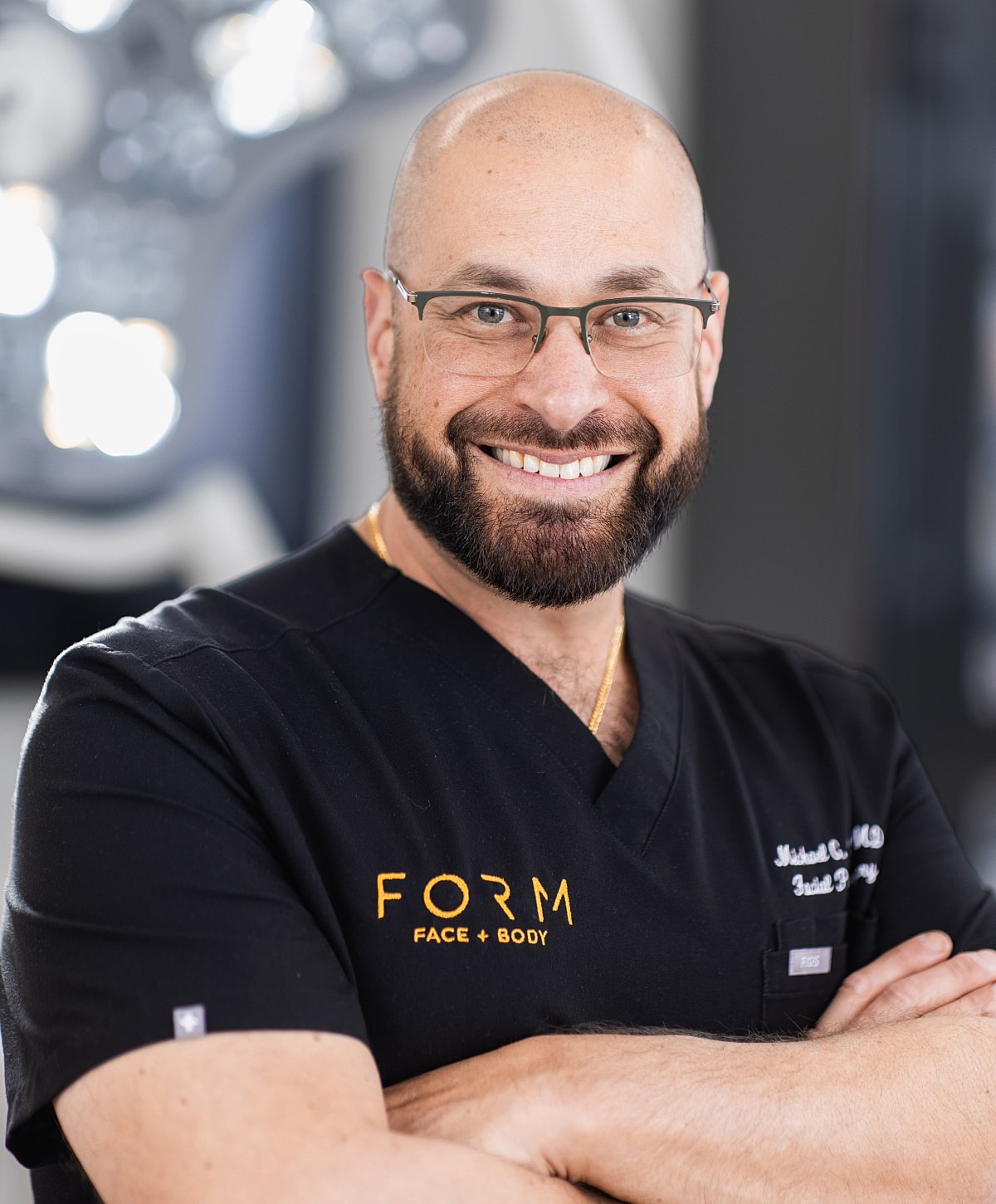
Dr. Michael Brandt is a Royal College-certified Otolaryngology – Head and Neck Surgeon specializing in facial plastic and reconstructive surgery. He is fellowship-trained in facial plastic surgery and serves as an Assistant Professor at the University of Toronto, where he contributes to surgical education and research.