Published
6 minute read
A patient sat across from me last year, in very good shape, and said something I hear constantly in different words: "I've done the work. I train, I eat well, I've lost the weight. And my midsection still doesn't respond, and my back still bothers me by Friday."
She wasn't asking for surgery. She was asking a harder question: what do you do when you have already done everything reasonable, and there is still a gap between the effort you put in and the way your body looks and works.
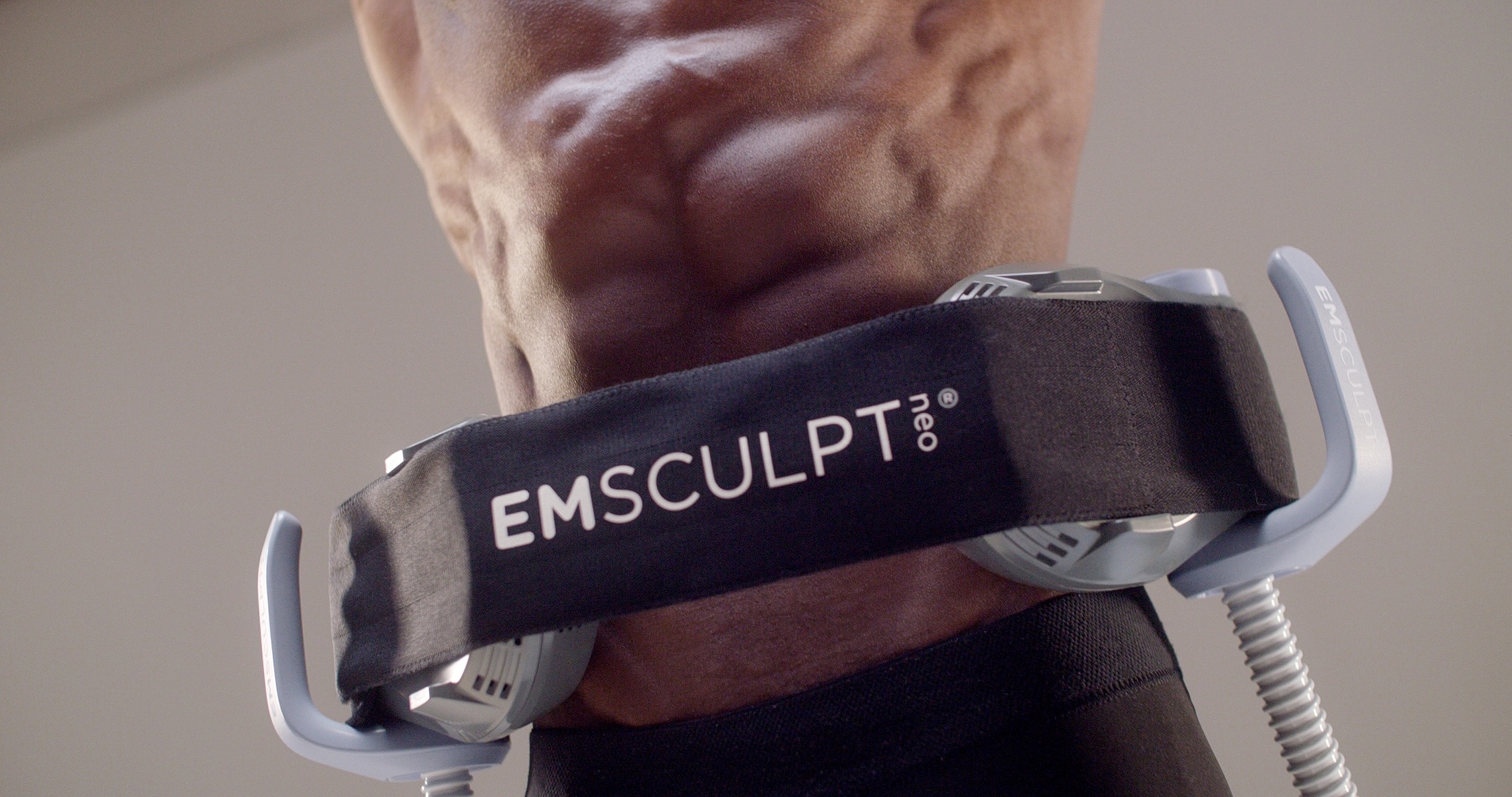
That question is one of the main reasons EMSculpt is in our building.
It would be easy to file this under body contouring and move on. That framing is too small, and it is the reason a lot of clinics get this technology wrong.
The deep core is not decorative. It is load-bearing. It stabilizes the spine, influences posture, and carries a share of the work in almost every movement you make. When it is weak or separated, the consequences show up as back discomfort, poor stability, less confidence lifting, and a shape that no amount of fat loss quite resolves.
So the problem wasn't how to flatten an abdomen. It was how to improve the muscle itself, in people who cannot train their way to the result, in people recovering from pregnancy or surgery, and in people who simply want more capacity than they have now. Don’t get me wrong – the aesthetic part of this is also super important!
Most places sell only the first of these. We brought EMSculpt in for all four.
Aesthetics. The contour of the midsection, flanks, arms and glutes. Real, and worth wanting, but the narrowest of the four reasons.
Function. A stronger, better-coordinated core changes how you stand, lift and move under load. Many patients notice this first and end up valuing it most, even when the aesthetic result is what brought them in.
Recovery. After pregnancy, after abdominal surgery, after an injury that has kept you from training. This is the window where conventional advice often amounts to waiting, and where rebuilding muscle without loading a healing structure has genuine value.
Long-term optimization. Preserving muscle is one of the more reliable investments a person can make in how well they function at seventy and eighty. Nobody needs a problem to justify that.
Nothing enters this building because it is popular or because a rep was persuasive. EMSculpt went in front of the surgical team at FORM Face + Body, the longevity clinicians in FORM Life+, and our pelvic health and postpartum expertise through FORM Women's Health powered by Eleve. Each was asked the same two questions: does this do something we cannot already do better another way, and would you put a member of your own family on it.
The surgical answer is worth stating plainly. EMSculpt is not a substitute for abdominoplasty. If there is significant skin laxity or a wide, symptomatic separation, the honest answer is surgical repair, and we say so. What it offered instead was something for the patient who is not a surgical candidate and does not want to be one, and a way to improve core quality before and after surgery.
Three disciplines, three different reasons, one technology. That convergence is what made the decision.
Outcomes here depend almost entirely on assessment and protocol, so that is where we put the effort. We examine the abdominal wall, measure separation where relevant, ask about back pain and pelvic floor symptoms, and say directly when surgery is the better answer. Some patients leave that assessment being told this is not what they need.
We also treat it as part of a plan rather than a standalone service, usually alongside sustainable resistance training, adequate protein, and where appropriate the metabolic and hormonal work our Life+ clinicians handle. The technology raises the ceiling on what training produces. It does not replace the training. And we measure results rather than relying on impression.
It is not appropriate during pregnancy, or for patients with cardiac pacemakers, implanted defibrillators, or metal or electronic implants in the treatment area. There are other contraindications we screen for individually.
The most important question! Our standard is to review the published literature, weigh study quality rather than headline numbers, discuss it across disciplines, and then measure our own patients to confirm the effect we intended. EMSculpt cleared that bar with three separate sets of clinicians here, and it holds an active Health Canada medical device licence. The literature also has real limitations, and some claims made about this technology in the market are not supported by it.
That deserves more than a paragraph, so it is getting its own article: the actual studies, how large the measured changes really are, where the evidence is thin, and our own patient outcomes and imaging. It is coming shortly.
The patient plateaued in the core despite consistent training. The postpartum patient with a mild to moderate separation who does not need surgery. The patient with back discomfort tied to a weak core who cannot load a barbell yet. The patient rebuilding after an abdominal procedure. The patient in their seventies for whom rising from a chair easily matters more than a flatter profile.
And the patient with no problem at all who simply wants more capacity. That is an entirely legitimate reason to be here.
Very few people we treat with EMSculpt are treated only with EMSculpt. It sits alongside surgical planning, hormonal and metabolic optimization, pelvic health and strength programming, because the concern a patient arrives with almost never belongs to one discipline. Having those experts in one building is not a convenience. It is why the plan is better than the sum of its parts.
If you are wondering whether this applies to you, the right next step is an assessment, not a booking. We will tell you plainly if something else would serve you better.