Published
12 minute read
Walk into a beauty store or spend five minutes on TikTok and skincare can start to feel like a full-time job.
Cleanser. Toner. Essence. Ampoule. Serum. Eye cream. Peptides. Acids. Growth factors. Sheet masks. Sleeping masks.
Then someone tells you the order matters, another person says you need ten steps, and a skincare company launches one more product that apparently needs to fit between steps six and seven.
I think we have made this much more complicated than it needs to be.
If your goal is healthier skin and prevention of premature skin aging, the core routine is remarkably simple:
Sunscreen. Retinoid. Moisturizer.
Everything else is optional and should be added for a reason.
This isn't the glamorous answer.
It is probably the most important one.
Ultraviolet radiation contributes to wrinkles, pigmentation, loss of elasticity and skin cancer. If you spend money trying to stimulate collagen while continuing to expose your skin to UV radiation without protection, you are working against yourself.
We actually have randomized controlled evidence for this.
In a study of more than 900 adults followed for four and a half years, people assigned to daily sunscreen use had significantly less skin aging than people who used sunscreen only when they felt they needed it. [1]
So before we discuss peptides, vitamin C or the newest Korean serum:
Wear sunscreen.
For daily use, I recommend a broad-spectrum SPF 30 or higher. In practice, I often prefer SPF 50 for patients who are serious about preventing sun damage, particularly if pigmentation is a concern.
Broad spectrum matters because SPF mainly tells us about protection from UVB, the radiation most associated with sunburn. We also want protection from UVA, which penetrates deeper and contributes significantly to skin aging.
The other issue is quantity.
Most people don't use enough sunscreen to get the protection written on the bottle. Apply a generous, even layer over the entire face and don't forget the ears and neck.
Put sunscreen on after your skincare and before makeup.
If you're spending significant time outdoors, reapply about every two hours and after swimming, heavy sweating or towelling off.
The best sunscreen isn't necessarily the most expensive one.
It is the one you will actually wear every day.
One of the best contributions Korean skincare has made to the skincare conversation is the idea that sunscreen should be pleasant enough to use every day.
That sounds trivial.
It isn't.
If a sunscreen feels greasy, leaves a heavy white cast, pills under makeup or stings your eyes, you probably won't use it consistently.
Many Korean and other Asian sunscreens have become popular because the formulations can feel more like lightweight skincare than traditional beach sunscreen.
That is valuable.
The important part isn't that the sunscreen is Korean.
The important part is that you like it enough to use the correct amount every morning.
Consistency beats the theoretically perfect product sitting unused in your bathroom cabinet.
If sunscreen is primarily about protecting what you have, a retinoid is one of our best-supported topical tools for improving skin.
Retinoids are derivatives of vitamin A.
They influence how skin cells mature and can affect collagen production, pigmentation, acne and skin texture.
Of all the ingredients marketed as “anti-aging,” prescription tretinoin has some of the strongest evidence.
A 2025 systematic review and meta-analysis of eight randomized trials involving more than 1,300 patients found that topical tretinoin significantly improved both fine and coarse facial wrinkles caused by sun damage. [2]
That is a much stronger evidence base than exists for most expensive anti-aging serums.
They are all part of the retinoid family, but they are not identical.
Tretinoin is already in its active form and is available by prescription. It has the strongest evidence for photoaging.
Retinal, sometimes called retinaldehyde, requires a conversion step in the skin before becoming active.
Retinol requires additional conversion and is generally gentler but also less potent.
For someone new to retinoids or with sensitive skin, an over-the-counter retinol or retinal product can be a reasonable starting point.
For someone specifically looking for the strongest evidence-based treatment for photoaging, I generally favour tretinoin when appropriate.
The important point is not to choose the strongest product you can tolerate for three nights.
It is to choose a product you can use consistently for years.
This is where a lot of people get into trouble.
They buy a strong product, use too much every night, become red and flaky, decide their “skin barrier is destroyed,” and stop.
That isn't a failure of retinoids.
It is often a dosing problem.
At night, gently cleanse your face and let the skin dry.
Use about a pea-sized amount for the entire face. More is not better. Avoid putting it directly on the eyelids, lips and the creases beside the nose when you're starting.
Begin slowly.
Two nights a week is completely reasonable at first. If your skin is comfortable, gradually move toward every other night and eventually more frequently if tolerated.
Then apply moisturizer.
If you're particularly sensitive, you can apply moisturizer first, then the retinoid, and another small amount of moisturizer afterward. This is sometimes called the “sandwich” method.
You do not earn extra points for peeling.
Irritation is a side effect, not evidence that the product is working.
Retinoids should not be used during pregnancy. If you are pregnant, trying to become pregnant or breastfeeding, discuss your skincare with your healthcare provider.
Moisturizer isn't exciting.
It doesn't need to be.
Its job is to support the skin barrier and reduce water loss.
A healthy skin barrier helps keep water in and irritants out. Moisturizers can contain humectants, which attract water; emollients, which smooth the spaces between skin cells; and occlusives, which reduce water loss from the surface.
Ingredients such as glycerin, ceramides, hyaluronic acid and petrolatum can all be useful depending on the formulation and your skin type. [3]
If your skin is oily, you may prefer a lighter lotion or gel-cream.
If you're dry, a richer cream may make more sense.
If you're sensitive, I usually favour simple, fragrance-free formulations.
You don't need a $300 moisturizer to have a healthy skin barrier.
And if your moisturizer already contains good humectants, you may not need a separate hyaluronic-acid serum underneath it.
You probably need to clean your face.
But I don't consider cleanser one of the major “anti-aging actives.”
Its job is simply to remove sunscreen, makeup, oil and debris without irritating your skin.
At night, use a gentle cleanser.
If you're wearing heavy makeup or a very water-resistant sunscreen, a double cleanse can be useful. That usually means an oil or balm cleanser followed by a gentle water-based cleanser.
But double cleansing isn't mandatory for everyone.
And your face should not feel squeaky after cleansing.
That tight, stripped feeling is not evidence that your skin is especially clean.
It may simply mean you've removed too much of the lipid barrier.
There is a lot I like about the philosophy behind Korean skincare.
K-beauty has helped move people away from attacking their skin and toward hydration, barrier support, gentle treatment and daily sun protection.
Those are good principles.
Where I think things go off track is when the philosophy becomes a product count.
There is no rule in skin biology that says an essence must follow a toner, followed by an ampoule, followed by two serums, followed by a sheet mask.
The famous “10-step routine” should be thought of as a menu, not a prescription.
Your skin doesn't know how many products you own.
It responds to ingredients, formulations and consistency.
Morning: Gently cleanse if you need to, or simply rinse if your skin does well that way. Apply moisturizer if your skin needs it. Finish with a generous layer of broad-spectrum SPF 30 or higher. Sunscreen should be the final skincare step before makeup.
Evening: Remove sunscreen and makeup with a gentle cleanser. Let your skin dry, apply a pea-sized amount of your retinoid on the nights you use it, then apply moisturizer. Or alternatively, mix the pea size retinoid with your moisturizer right on your palm and apply the mixture.
That's it.
For many people, that is an excellent skincare routine.
This is where we can start adding products.
But every additional product should answer a question.
What problem am I trying to solve?
Vitamin C has evidence for pigmentation and photoaging and can be a reasonable morning antioxidant.
Niacinamide has evidence for redness, pigmentation and oil control and can also support the skin barrier. There is also growing evidence to support Niacinamide for skin cancer prevention – for this purpose, take it as a nutraceutical capsule 500mg twice daily.
Azelaic acid can be very useful for acne, pigmentation and redness.
Salicylic acid can help oily and acne-prone skin.
Glycolic acid can help selected patients with texture and pigmentation.
A 2025 consensus involving cosmetic dermatologists from 43 centres found support for ingredients including retinoids, sunscreen, vitamin C, niacinamide, azelaic acid, glycolic acid, salicylic acid and benzoyl peroxide depending on the skin concern being treated. [4]
Notice the phrase:
depending on the skin concern.
You do not need all of them.
Some may be useful.
Some have interesting early evidence.
Some are mainly good moisturizers in more interesting packaging.
And some probably do very little.
I don't object to a product simply because the evidence isn't as strong as it is for tretinoin.
Skincare can also be enjoyable.
If you love your essence and it makes your skin feel better, use it.
If snail mucin hydrates your skin and you like it, that's fine.
But I would put these products on top of the foundation, not instead of it.
Don't skip sunscreen because you spent $180 on a peptide serum.
Usually not.
Many eye creams are essentially moisturizers sold in smaller containers.
There can be exceptions when an eye product contains a specific active ingredient or formulation designed for that area.
But if you are using a gentle moisturizer that you tolerate around the eyes, you do not automatically need another product because the jar says “eye cream.”
This is a good example of separating skincare biology from skincare marketing.
Every additional product introduces another group of ingredients.
That means another opportunity for irritation, allergy, acne or an interaction with something else in your routine.
This is particularly important when people combine several acids, a retinoid, vitamin C and multiple exfoliating products because each one was independently described as “good for skin.”
Individually good ingredients do not automatically create a good routine when you pile them together.
The skin barrier matters. Modern research increasingly recognizes it as a complex system involving physical, chemical, microbiological and immune functions. [3]
A routine that is so aggressive that your skin is chronically red, burning or peeling is not an advanced skincare routine.
It's an irritated face.
Skincare companies make more money when your routine has nine products instead of three.
That doesn't mean skincare companies are dishonest.
It means their incentives and yours are not always identical.
Your goal is better skin.
Their goal is to sell skincare.
Sometimes those interests align beautifully.
Sometimes they don't.
That is why I prefer to start with the treatments that have the strongest evidence and then add products only when they solve a specific problem.
If I wanted to create the highest-value, evidence-based routine for most adults interested in maintaining skin quality and slowing visible photoaging, I would start with three things:
Sunscreen in the morning.
A retinoid at night.
Moisturizer to support the skin barrier and make the routine sustainable.
Then customize.
Pigmentation? We can add something for pigmentation.
Acne? Treat the acne.
Redness? Treat the redness.
Dryness? Adjust the moisturizer.
But don't confuse complexity with sophistication.
At FORM Face + Body in Toronto, our approach to skincare is the same as our approach to procedures:
Use what works. Use enough to solve the problem. Don't add treatment just for the sake of treatment.
Good skincare doesn't need to take 45 minutes.
It needs to be something you can actually do every day.
Prescription and over-the-counter skincare products are not appropriate for everyone. Retinoids can cause irritation and are generally avoided during pregnancy. Patients with acne, rosacea, eczema, pigmentation disorders or other skin conditions may benefit from an individualized treatment plan. This article is educational and is not a substitute for personal medical advice.
written by
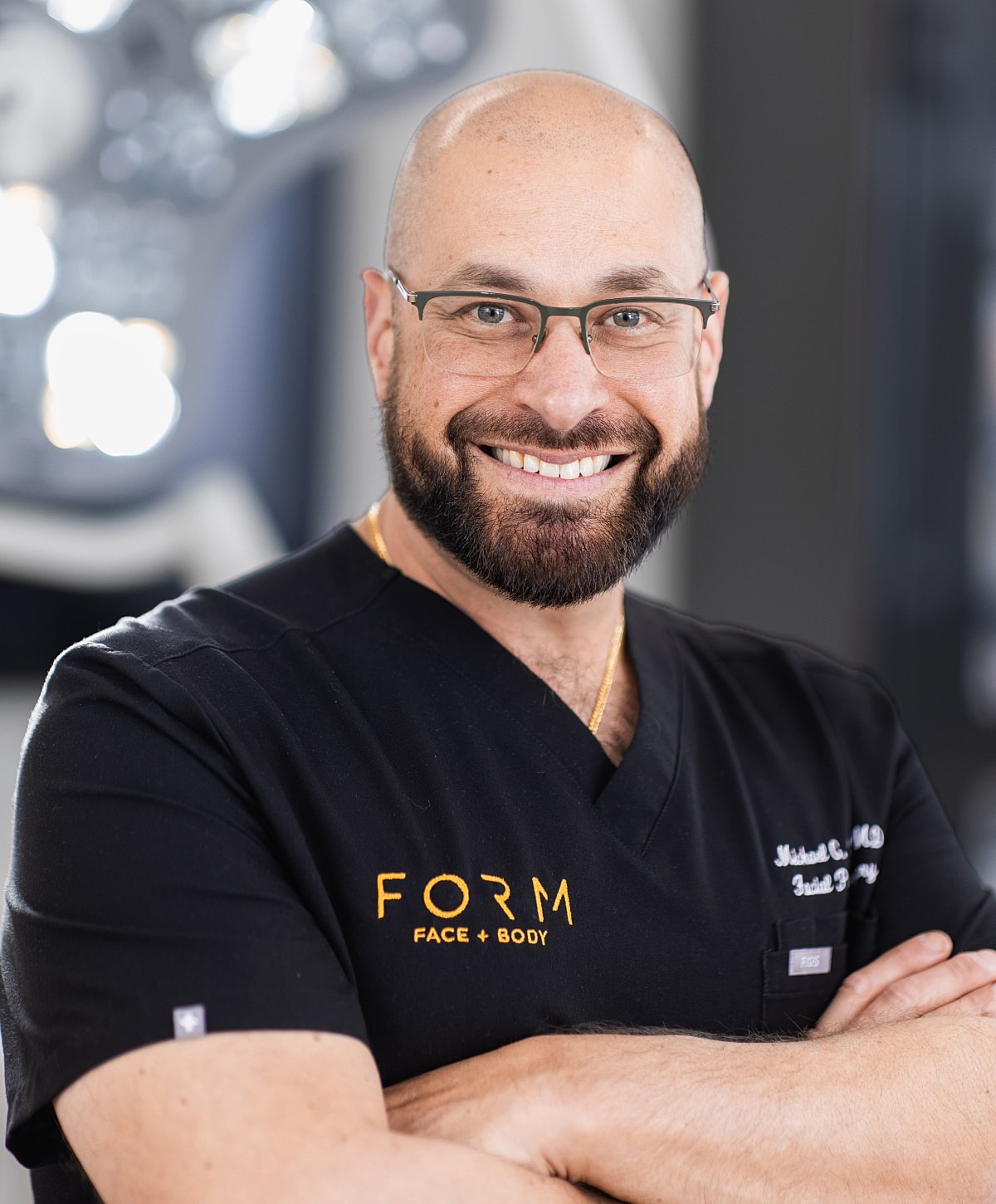
Dr. Michael Brandt is a Royal College-certified Otolaryngology – Head and Neck Surgeon specializing in facial plastic and reconstructive surgery. He is fellowship-trained in facial plastic surgery and serves as an Assistant Professor at the University of Toronto, where he contributes to surgical education and research.