Published
20 minute read
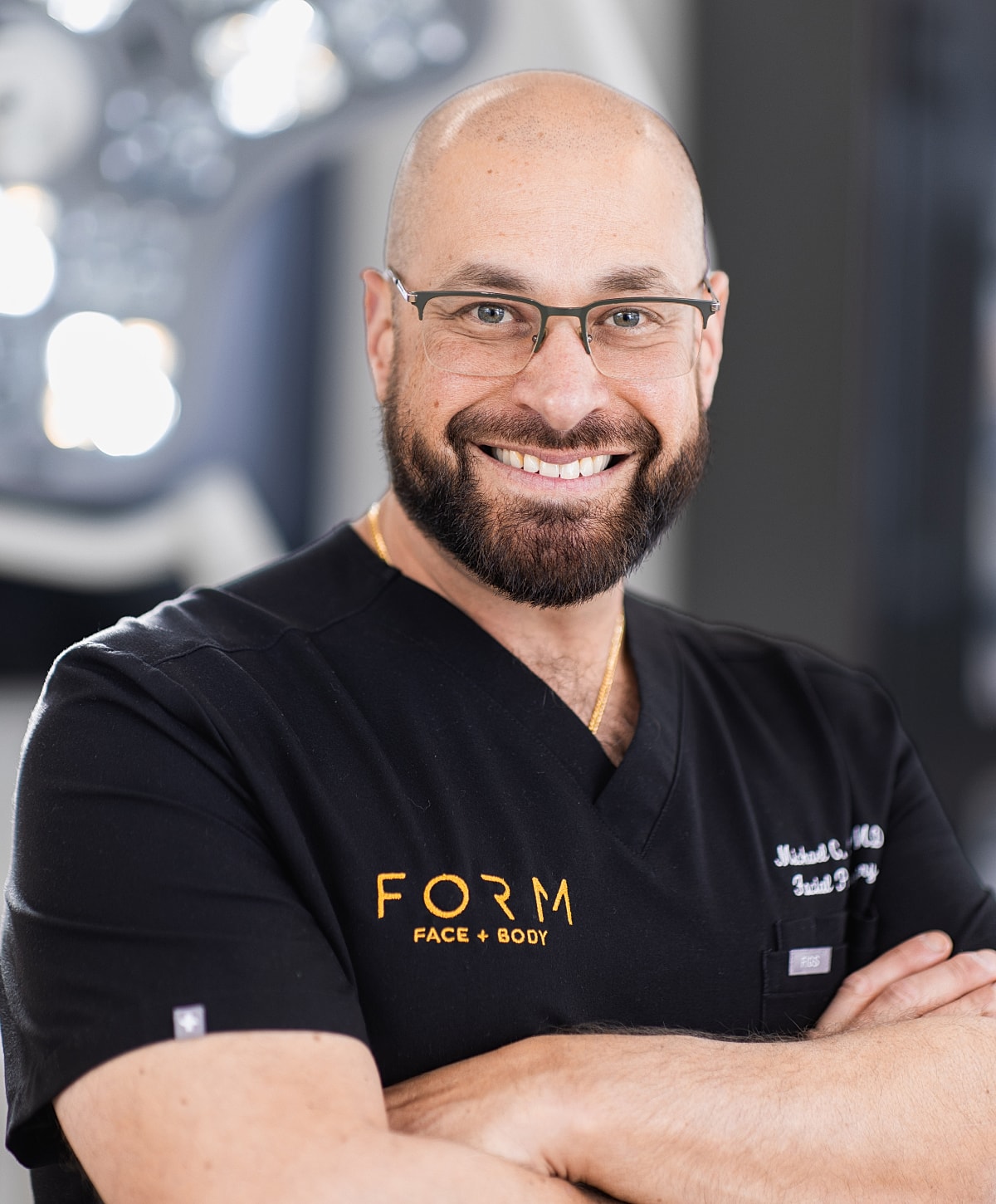
By Dr. Michael Brandt, MD, MSc, EMBA, FRCSC, Otolaryngology Head and Neck Surgeon, FORM Face + Body, Toronto
You can be slim, exercise regularly and still have a heavy neck or a double chin. And you can spend a considerable amount of money trying to treat it without getting much closer to the jawline you're hoping for.
The problem is that not every full neck is caused by fat immediately beneath the skin. Some of the fullness may sit underneath a muscle called the platysma. Other deep structures, including the digastric muscles and submandibular glands, can also affect the contour. Add loose skin or a relatively small chin, and the angle between the chin and neck can become much less defined.
We call this an obtuse cervicomental angle. In plain language, the neck flows into the underside of the chin rather than forming a clear, defined angle.
Here's the important part: fat-dissolving injections and conventional superficial liposuction cannot correct fullness that lies beneath the platysma. Skin-tightening devices don't remove it either. If deep anatomy is the reason your neck looks heavy, repeatedly treating the surface will not solve the underlying problem.
I don't offer BELKYRA fat-dissolving injections or cryolipolysis (fat freezing) at FORM. They can have a role in appropriately selected patients elsewhere, but neither treats deep neck fullness, and both have limitations worth understanding before spending money on a series of procedures. Fat freezing also carries a particularly counterintuitive complication: sometimes the treated fat enlarges instead of shrinking.
As a facial plastic and reconstructive surgeon, I think we should diagnose the layer causing the problem before choosing how to treat it. Sometimes a non-surgical skin-tightening approach is reasonable. Sometimes the better answer is a carefully planned operation, potentially including deep neck contouring.
The neck is more anatomically complicated than it looks. Its contour is influenced by several layers that can contribute to fullness in different ways.
Directly beneath the skin is superficial, or preplatysmal, fat. This is the soft fat that can often be pinched between the fingers. It may contribute to a double chin, particularly in someone with otherwise good skin elasticity.
Under that sits the platysma, a thin sheet of muscle extending across the front of the neck. As we age, the muscle and its supporting tissues can change, creating bands or a loss of definition.
Deeper still is subplatysmal fat. This is one of the most important—and frequently overlooked—contributors to an obtuse or heavy neck. Nearby structures, including the digastric muscles and submandibular salivary glands, can also create fullness beneath the jawline.
Finally, the underlying skeleton matters. A relatively small or recessed chin and a low-positioned hyoid bone can make the neck angle look less defined even in a person who has very little excess fat. Not every anatomical limitation can be completely corrected by surgery.
These distinctions matter because a treatment that works well for superficial fat may do very little for deep fullness.
BELKYRA is an injectable form of deoxycholic acid used to reduce selected deposits of fat immediately beneath the chin. It works by damaging fat cells in the treated area, which are then cleared as the tissue heals.
The distinction is where it works. BELKYRA is injected into superficial submental fat, above the platysma. The Canadian product monograph specifically warns against injecting into fat beneath the platysma. It also cautions against treating patients with excessive skin laxity or prominent platysmal bands when reducing fat could worsen the appearance.
That makes BELKYRA a poor match for the patient whose obtuse neck angle is caused mainly by subplatysmal fat, deep muscle anatomy or loose skin. It cannot reach the deeper volume responsible for that contour.
I don't offer BELKYRA in my practice. That doesn't mean it never works. In appropriately selected patients with a limited deposit of superficial fat and favourable skin elasticity, it can improve fullness. My objection is to treating a complex heavy neck as though it were simply a small superficial fat pocket.
Patients sometimes hear "non-surgical" and picture one quick appointment without much recovery. BELKYRA may be quite different. Each session involves multiple injections under the chin. The Canadian monograph allows as many as six treatment sessions spaced at least one month apart, although some patients require fewer.
Even in carefully selected clinical-trial patients, improvement was variable. Approximately 68% achieved at least a one-grade improvement on the combined clinician-and-patient submental fat scale, and about 16% achieved a two-grade improvement. Those results should not be extrapolated to patients whose main problem is deep fat or loose skin.
The Canadian clinical trials reported swelling in approximately 87% of treated patients, injection-site pain in 70% and bruising in 72%. Numbness and tenderness were also common. Patients can look more swollen before they look better, then return for another treatment and another period of recovery.
More significant complications include temporary marginal mandibular nerve weakness, which can cause an asymmetric smile, and difficulty swallowing. The product monograph reports marginal mandibular nerve injury in approximately 4% of treated patients in trials; most cases resolved, but some took months.
My concern is the overall burden: repeated injections, repeated swelling and discomfort, considerable expense, and the possibility of only modest improvement if the anatomy was poorly suited to the treatment in the first place. That is not the approach I want to offer someone with a genuinely heavy neck.
Neuromodulators can be useful for selected patients with visible platysmal bands—the vertical cords that become more apparent when the neck muscles contract. Relaxing those bands may soften their appearance, but it does not remove a significant fat pad or reshape a heavy neck. Effects are temporary, so repeat injections are generally necessary, often after several months. Treatment also has potential complications, including unwanted muscle weakness and swallowing problems.
Fillers have an even more limited role in this discussion. They add volume; they don't remove deep neck fat or resuspend a descended neck. A patient with a genuinely recessed chin may benefit from improving chin projection, but adding filler along an already heavy jawline can just make the lower face look bulkier. In someone with a truly obtuse neck angle, filler is not a substitute for deep contouring.
The question isn't whether an injectable can change the appearance slightly. It's whether that change addresses the structure responsible for the problem.
Devices using radiofrequency, focused ultrasound or laser energy can improve skin firmness in selected patients. At FORM Face + Body, I use technologies including XERF and laser resurfacing to address early laxity and skin quality where appropriate.
But tightening skin and removing deep volume are two very different things.
Someone with mild looseness and relatively little underlying fat may notice an improvement. Someone with significant subplatysmal fat is unlikely to obtain a sharply defined neck through skin tightening alone. A heavy neck may look modestly firmer without becoming substantially slimmer.
The number of treatments varies by technology and protocol. Some focused-ultrasound treatments are planned as a single session, with reassessment over subsequent months. Other radiofrequency or fat-reduction protocols involve several visits. A review by the American Academy of Dermatology notes that non-invasive fat-reduction approaches commonly require repeated sessions, with the number varying substantially by device.
There's a comfort and recovery cost as well. Patients may experience heat, aching or tenderness during treatment and transient swelling, redness or bruising afterward. A systematic review of microfocused ultrasound reported an average pain score of approximately 4.9 out of 10, although individual experiences varied widely.
More aggressive deep-energy treatments also deserve thoughtful consideration if a future facelift or neck lift is possible. Thermal injury and fibrosis in deeper tissues may complicate surgical dissection in some patients. The evidence varies by device, so I don't assume every radiofrequency or ultrasound treatment has the same effect, but I do think patients deserve that conversation before undergoing repeated procedures.
And once again, even a technically successful tightening treatment cannot remove a pocket of fat sitting beneath the platysma.
Cryolipolysis, commonly called fat freezing, is another non-surgical approach used elsewhere for selected superficial fat deposits. It cools tissue in an attempt to injure fat cells and gradually reduce the treated bulge over the following months. Some patients need more than one session.
I don't offer cryolipolysis at FORM. Like BELKYRA, it cannot selectively remove subplatysmal fat or correct loose skin, platysmal changes or unfavourable deep-neck anatomy. In a patient whose heavy neck is driven by those structures, treating the superficial fat is unlikely to deliver the contour they want.
One of the reasons I am cautious about fat freezing is a rare complication called paradoxical adipose hyperplasia, or PAH.
It is exactly what it sounds like: instead of decreasing, the fatty tissue in the treated region becomes larger. The area may develop a firm, obvious bulge, sometimes reflecting the shape of the treatment applicator. It may not become apparent until two to five months after treatment, when the patient expected the contour to be improving.
This isn't simply temporary swelling or a poor cosmetic response. The treated fat tissue has enlarged, and the condition generally does not resolve on its own. Some patients need liposuction or surgical excision, which can be challenging and does not guarantee a perfect correction.
A 2025 systematic review and meta-analysis of 28 studies involving 13,078 patients estimated PAH in approximately 0.22% of treated patients—roughly one in 455. The researchers rated the evidence as low certainty and highlighted underreporting and limited follow-up. That estimate combines several body areas and should not be interpreted as the specific risk for treatment beneath the chin.
The complication is uncommon, but it's real. And the irony matters: someone chooses a non-surgical treatment to reduce fat, only to develop more apparent fat and potentially require surgery to correct it.
More routine side effects include pain, bruising, redness, swelling, tenderness and temporary numbness. Less common complications can include prolonged sensory changes, contour irregularity, and cold injury or burns. The US Food and Drug Administration specifically warns that PAH may require surgical treatment and may not be completely corrected by surgery.
I would rather discuss what is actually producing the fullness in someone's neck than offer a treatment that cannot reach the main problem and carries risks that may be difficult to reverse.
Liposuction is a useful surgical treatment when the problem is excess superficial fat and the patient has enough skin elasticity to redrape smoothly.
But not all neck fat is superficial. Conventional submental liposuction works in the tissue above the platysma. It cannot safely be treated as a way of suctioning out the deep fat beneath that muscle, particularly around important nerves, blood vessels and salivary structures.
This is why I think the superficial-fat-only approach can miss the real cause of an obtuse neck. You can remove a significant amount of subcutaneous fat and still be left with a rounded, heavy contour if the fullness is coming from deeper tissue.
In some patients, aggressively removing superficial fat can even make the remaining deep structures more noticeable or produce unnatural contour irregularities. More suction is not necessarily the answer.
Before recommending liposuction, I want to understand whether the neck actually needs superficial fat reduction, muscle treatment, deeper contouring, skin redraping—or some combination.
A deep neck lift is not simply a regular neck lift with a more impressive name. It refers to an approach that considers and, when indicated, treats structures beneath the platysma rather than focusing only on skin and superficial fat.
The principle is straightforward: if the fullness causing the problem lies deep to the muscle, correction may require direct surgical access to those deeper structures.
In selected patients, deep neck contouring may involve reducing excess subplatysmal fat and addressing the platysma. Depending on the anatomy, the surgeon may also need to consider the size or position of the digastric muscles and submandibular glands. Those structures should not be altered routinely simply because a procedure is labelled a deep neck lift.
This distinction is well recognized in the surgical literature. Authors discussing deep neck contouring have emphasized that removing only superficial fat and tightening the platysma may leave the actual source of fullness untouched.
A patient with excess deep fat and good skin quality may require a different operation from someone with deep fullness, jowling and substantial loose skin. The latter patient may also need a facelift or a more extensive neck lift to redrape the skin and reposition the lower face.
These structures can contribute to a full neck, but their treatment is more involved than removing fat. The submandibular glands produce saliva and sit near nerves and blood vessels. The digastric muscles contribute to the structure and movement of the floor of the mouth and neck.
Selective modification may be appropriate in carefully chosen patients, but it adds complexity and risk. Possible complications include bleeding, temporary or persistent nerve weakness, salivary fluid collections, swallowing symptoms and contour irregularities. A recent systematic review of deep neck procedures found high patient satisfaction in published series but also greater concern about nerve complications than with more superficial neck-lift approaches.
The answer is not to operate on every deep structure. It's to identify what is causing the contour and address only what needs correction.
No. A low hyoid bone, short or recessed jaw, thick skin or other anatomical factors may limit the achievable contour even with excellent surgery. Some patients simply cannot obtain the extremely acute neck angle shown in heavily edited photographs.
I would rather explain those limitations before surgery than promise an anatomy-defying result.
Non-surgical treatments are often marketed around the price of a single session. But that may not reflect the true commitment.
Consider a patient who has undergone several rounds of fat-dissolving injections elsewhere, tried fat freezing or skin tightening, and then returns for another treatment because the contour still isn't what they wanted. They have now paid for multiple appointments, tolerated repeated discomfort and swelling, and spent months waiting to see what will happen. Some will have spent an amount that could have gone towards a surgical consultation and a more definitive treatment.
If their neck was heavy primarily because of subplatysmal fat or other deep structures, none of those treatments was designed to correct the main problem. By the time the patient considers surgery, they may have spent a substantial amount of money without achieving what they wanted.
Surgery has a larger upfront cost and a more significant recovery. It is not always cheaper, and it isn't appropriate for everyone. But for a patient with a clearly surgical anatomical problem, one properly planned operation may provide a more direct, substantial and durable correction than a prolonged series of treatments with limited potential.
I sometimes describe this as the difference between paying repeatedly to camouflage a problem and addressing the actual source of it.
Of course, "one and done" should not be interpreted as a lifetime guarantee. Ageing continues, weight can change and occasional revisions are necessary. The advantage of surgery is that it can directly alter the anatomical structures responsible for a heavy neck—not that it stops time.
A deep neck lift involves surgery and needs to be approached accordingly. Swelling, bruising, tightness, numbness and temporary changes in neck sensation are expected parts of the recovery process.
Many patients need roughly one to two weeks away from work or social commitments, depending on the extent of surgery and how they heal. Exercise restrictions typically last longer, and the finer details of the neck contour may continue evolving for several months.
The risks include bleeding, hematoma, infection, scarring, altered sensation, asymmetry and injury to nearby nerves or salivary structures. Working deeper in the neck can introduce additional risks compared with superficial liposuction or a limited neck lift.
I believe that should be discussed just as openly as the benefits. A more anatomically complete operation is not automatically the right operation for every patient.
When someone comes in concerned about a double chin or an obtuse neck angle, I examine more than the amount of tissue under the skin.
I assess the superficial fat, skin quality, platysmal bands, jawline, chin projection and the deeper structures that influence neck contour. I also consider changes in weight, previous procedures and the patient's overall health.
The question is whether the problem is primarily superficial fat, skin laxity, deep volume, muscle anatomy or a combination.
If the concern is a small superficial fat deposit with good skin elasticity, limited liposuction may be an option; patients who prefer non-surgical treatment can also be counselled on its limitations, although I don't offer BELKYRA or cryolipolysis. If the issue is mild skin laxity, a treatment such as XERF, sometimes combined with laser resurfacing, may make sense. If there's substantial deep fullness, I explain why a deep neck approach may be necessary for meaningful contour improvement.
And if the examination suggests an unusual mass or medical rather than cosmetic cause of neck swelling, that needs medical evaluation before any aesthetic treatment.
Genetics, chin projection, skin characteristics, muscle anatomy and deep subplatysmal fat can all influence the angle between the chin and neck. Body weight is only part of the explanation.
No. BELKYRA is intended for selected superficial fat beneath the chin. The Canadian prescribing information directs treatment above the platysma and warns against injecting into deeper fat. It is not a treatment for subplatysmal fullness.
I don't offer BELKYRA because the heavy necks I assess frequently involve more than a small superficial fat deposit. BELKYRA cannot treat fat beneath the platysma, may require multiple uncomfortable sessions and may provide limited improvement when the problem is deeper anatomy or skin laxity. It has a role in selected patients, but it is not part of my neck-contouring approach.
Yes, although it is uncommon. Paradoxical adipose hyperplasia is a recognized complication in which the treated fatty area enlarges rather than shrinks. A 2025 meta-analysis estimated a pooled incidence of about 0.22% across treated body regions, with low certainty. The enlarged area may persist and require surgery. I do not offer cryolipolysis.
It can work well when excess superficial fat is the main concern and the skin has sufficient elasticity. It will not remove deep subplatysmal fat, correct prominent salivary glands or reposition descended tissues. In a patient with significant deep fullness, liposuction alone may leave the neck looking heavy.
Not exactly. Deep neck contouring addresses selected structures beneath the platysma, while a facelift repositions tissues of the lower face and often helps with neck skin and jawline definition. Some patients benefit from a combined procedure; others do not need both.
That depends on the anatomy. If the concern is mild and superficial, selected non-surgical treatments may offer a worthwhile improvement. If the neck contour is dominated by deep fat or other subplatysmal structures, surgery is usually the more direct option for substantial change. The decision should weigh cost, expected improvement, recovery and risk—not just the price of the next appointment.
I have nothing against non-surgical treatments. They are valuable when we choose them for problems they can actually address.
But if someone has an obtuse, heavy neck because of subplatysmal fat or other deep structures, fat-dissolving injections, fat freezing, skin tightening and superficial liposuction cannot reliably correct the underlying anatomy. Repeating them doesn't change that limitation. That's why I don't offer BELKYRA or cryolipolysis, and why I won't recommend a treatment simply because it avoids surgery.
Sometimes the best solution is a more definitive operation that directly addresses the source of the fullness. And sometimes a smaller treatment is all that's needed. The important step is figuring out which situation applies before committing to a plan.
At FORM Face + Body in Toronto, I evaluate the neck in the context of the whole face—superficial fat, deep structures, skin, muscle and jawline. If you're frustrated by a heavy neck or double chin, I invite you to come in for an assessment. We'll discuss what's actually creating the contour, what can realistically improve it, and whether non-surgical treatment, liposuction or a deep neck lift makes the most sense.
written by
Dr. Michael Brandt is a Royal College-certified Otolaryngology – Head and Neck Surgeon specializing in facial plastic and reconstructive surgery. He is fellowship-trained in facial plastic surgery and serves as an Assistant Professor at the University of Toronto, where he contributes to surgical education and research.