Published
13 minute read
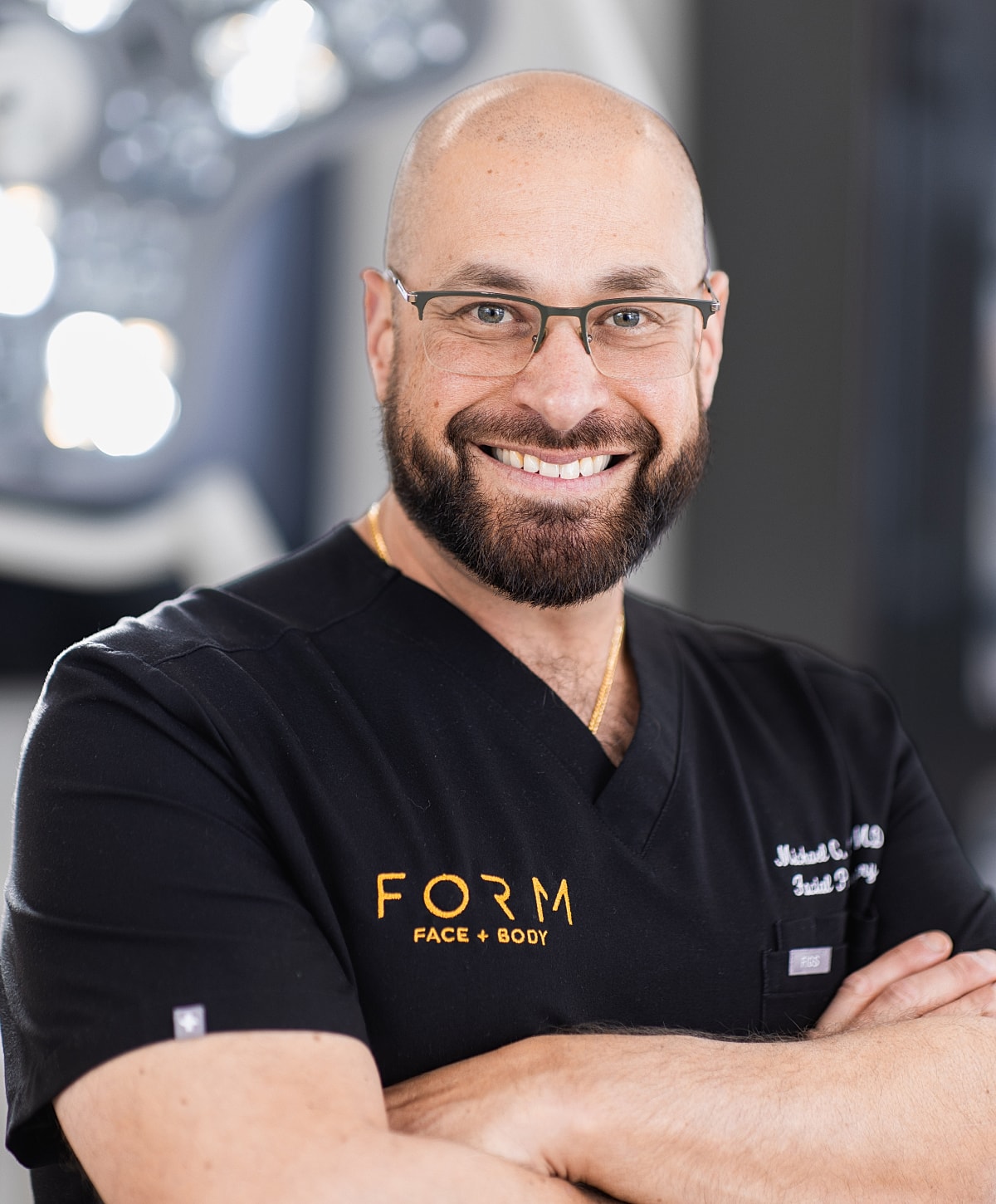
By Dr. Michael Brandt, MD, MSc, EMBA, FRCSC, Otolaryngology Head and Neck Surgeon, FORM Face + Body, Toronto
Can you get rid of jowls without surgery? Sometimes. But the answer depends on how much jowling you have.
For patients with mild, early jowling, non-surgical treatments such as XERF radiofrequency skin tightening combined with laser resurfacing may help improve the jawline and skin quality.
For patients with more substantial jowling, where the tissues of the lower face have visibly descended, surgery is generally the more effective solution.
And filler? It can help in selected situations, but adding filler to an already heavy lower face can sometimes make things worse.
As a facial plastic and reconstructive surgeon, I offer both surgical and non-surgical facial rejuvenation treatments. This allows me to recommend the approach that makes the most sense for the individual patient rather than trying to solve every problem with the same technology.
The starting point is understanding what's actually causing the jowls.
A youthful jawline typically has a relatively smooth contour extending from the chin towards the angle of the jaw.
As we age, several changes can interrupt that contour.
Our skin gradually loses some of its collagen and elasticity, making it less capable of maintaining its original firmness. The deeper fat and soft tissues of the face also change position, with some descending towards the jawline.
Changes in facial bone structure and the supporting ligaments further influence how the lower face ages.
And, of course, genetics plays a role. Some people naturally have heavier lower faces or develop jowls earlier than others.
These changes don't occur at the same rate in everyone. I've seen patients in their 40s with pronounced jowling and patients in their 60s with remarkably well-preserved jawlines.
That's why I don't recommend treatments based simply on age. I recommend them based on anatomy and the severity of the problem.
More importantly, we need to distinguish between skin that has become slightly loose and facial tissues that have actually descended. These are different problems, and they require different solutions.
When someone is beginning to notice early jowling, but the lower facial tissues haven't descended significantly, non-surgical treatments may provide a worthwhile improvement.
At FORM Face + Body, one approach I favour for appropriately selected patients combines XERF radiofrequency skin tightening with laser resurfacing.
These technologies address different components of facial ageing, and using them together allows us to target both tissue firmness and skin quality.
XERF uses monopolar radiofrequency energy to heat tissue at different depths, with the goal of stimulating collagen remodelling and improving skin firmness.
In patients with mild lower facial laxity, this may produce an improvement in the appearance of the jawline.
But there's an important distinction here.
XERF doesn't surgically reposition the facial tissues. It works by encouraging changes within the existing tissue that may improve firmness and create a modest tightening effect.
Early clinical studies have shown encouraging improvements in facial laxity, although the available research remains relatively limited, particularly regarding long-term results.
For someone with early jowling, these changes may be enough to achieve the improvement they're looking for.
For someone with heavy, descended jowls, they won't come close to replicating a facelift.
The second part of the approach is laser resurfacing.
At FORM, we use the Alma Hybrid platform, which allows us to combine fractional CO2 and non-ablative 1570 nm laser treatments according to the patient's needs.
Laser resurfacing can help improve fine lines, uneven texture, sun damage and certain aspects of skin laxity.
Fractional CO2 treatment stimulates a wound-healing response and collagen remodelling, which can provide some skin tightening. The amount of improvement varies with treatment intensity, skin characteristics and the severity of laxity.
The laser component is particularly useful when a patient has early jowling accompanied by changes in skin texture and quality.
However, laser resurfacing cannot lift significant amounts of descended facial tissue.
I frequently discuss the concept of treatment stacking: combining complementary technologies to address different aspects of facial ageing.
With early jowling, XERF targets tissue firmness, while laser resurfacing addresses the quality of the skin and may provide additional tightening.
The objective is to improve the overall appearance of the lower face rather than relying on a single treatment to solve multiple problems.
Not every patient needs both technologies. Treatment selection depends on skin quality, the degree of laxity, medical history and how much recovery time a patient can accommodate.
It's also important to recognize that while the individual technologies have a clinical rationale, we still need stronger comparative evidence to establish how much additional benefit this specific combination provides.
My message to patients is straightforward: if your jowls are mild, non-surgical treatment may be enough. If your jowls are substantial, don't expect XERF and laser to deliver a surgical result.
This is where I think patients need particularly careful advice.
Fillers are frequently promoted as a way to restore jawline definition or achieve a non-surgical facelift.
And there are situations where they can help.
For example, a small depression immediately in front of the jowl, known as the prejowl sulcus, may be improved with carefully placed filler. In someone with a naturally small or recessed chin, strategically adding volume can sometimes improve the overall proportions of the lower face.
But filler doesn't eliminate sagging skin, and it doesn't truly lift a descended jowl.
When the lower face is already heavy because the tissues have descended, adding more volume can make the problem worse.
You may temporarily camouflage an irregularity along the jawline, but the trade-off can be a wider, fuller or less natural-looking lower face.
This is the fundamental difference between replacing volume that has been lost and trying to disguise tissue that has moved downwards.
They're not the same problem.
Imagine someone with noticeable jowls who wants a sharper jawline. Adding filler around those jowls might create the appearance of a straighter contour from one angle, but it doesn't remove the tissue responsible for the problem.
In some patients, it simply makes the lower face look bigger.
And when filler is repeatedly added over several years to compensate for increasing laxity, the result can move progressively further away from the natural facial contour the patient originally wanted.
This is why I'm conservative about lower-face filler.
If someone has a genuine volume deficiency and minimal laxity, filler may be appropriate.
If someone already has a heavy lower face and significant jowling, adding more volume is generally not my preferred solution.
Sometimes the right recommendation is to stop adding filler.
Once the tissues of the lower face have descended enough to produce obvious jowls, non-surgical treatments become increasingly limited.
This is where surgery has a clear advantage.
A facelift allows us to reposition the deeper tissues of the lower face, improve the contour of the jawline and address excess skin.
Rather than camouflaging the jowls with filler or hoping for modest tissue contraction from an energy-based treatment, we're directly correcting the underlying tissue descent.
For patients with substantial jowling who want meaningful correction, a facelift is generally the most effective option.
That doesn't mean everyone with jowls should have surgery.
Some patients prefer a more modest improvement without the downtime, expense or risks of an operation. That's a reasonable choice, provided they understand what non-surgical treatments can and cannot accomplish.
But I'm not going to recommend repeated tightening treatments to someone with significant jowling while suggesting they'll eventually achieve the same result as a facelift.
They won't.
And I think it's important to tell patients that before they spend thousands of dollars pursuing an outcome that the technology simply cannot deliver.
No.
There are several established approaches to facelift surgery, including SMAS plication and deep plane techniques.
I don't believe the name of a facelift technique should determine the operation.
The appropriate approach depends on the patient's anatomy, tissue descent, skin quality, neck changes and desired outcome.
Someone with significant jowling but relatively good neck definition may need a different surgical plan from someone with extensive lower facial and neck laxity.
The technique should be selected to address the anatomy rather than the other way around.
During a consultation, I evaluate the lower face and neck together.
I'm looking at skin laxity, the position and volume of the deeper tissues, jawline contour, skin quality and whether there are changes in the neck that contribute to the overall appearance.
I also assess whether previous filler treatments have changed the facial contour.
The severity of the jowling is one of the most important factors in determining what I recommend.
If the jawline is beginning to soften but the deeper tissues remain relatively well positioned, I may recommend non-surgical treatment.
XERF, potentially combined with laser resurfacing, can be a reasonable approach to improving skin firmness and quality.
The goal is a subtle improvement rather than a dramatic transformation.
This is often where the conversation becomes more nuanced.
Non-surgical treatment may provide some improvement, but the results will be limited by the amount of tissue descent.
For someone who wants a relatively small change without surgery, that may be acceptable.
For someone who wants a noticeably sharper jawline, surgery may offer a more predictable and meaningful result.
My role is to explain that difference clearly so patients can make an informed decision.
When the lower facial tissues have substantially descended and the jawline has lost its definition, surgery is generally the best option for meaningful correction.
A facelift, sometimes combined with a neck lift, addresses the underlying anatomy in a way that fillers and skin-tightening devices cannot.
At this stage, I don't believe repeated non-surgical treatments are a reasonable substitute for surgery if the patient's goal is substantial improvement.
Recovery is an important part of choosing between surgical and non-surgical treatments.
XERF generally involves relatively little downtime, although temporary redness, swelling and discomfort can occur. Radiofrequency treatments also carry risks, including burns and unwanted tissue changes.
Laser resurfacing can require several days or longer of visible healing, depending on the intensity of treatment. Pigmentation changes, infection and scarring are potential complications that need to be discussed.
A facelift involves a more significant recovery period. Most patients should expect visible swelling and bruising during the first couple of weeks, although healing continues well beyond that period.
Surgery also carries risks, including bleeding, infection, scarring, wound-healing problems and nerve injury.
The difference is the magnitude of improvement we're trying to achieve.
Non-surgical treatments may improve skin firmness and produce subtle changes in contour.
Surgery allows us to reposition the tissues responsible for more substantial jowling.
Neither option is automatically right for everyone.
Mild jowling can sometimes be improved with non-surgical treatments such as XERF radiofrequency tightening and laser resurfacing. These treatments may improve skin firmness and produce modest contour changes, but they cannot reliably correct significant tissue descent. More substantial jowls generally require surgery for meaningful correction.
Neuromodulators can sometimes provide a subtle improvement in selected patients by relaxing muscles that influence the lower face and neck. However, they cannot remove loose skin or reposition descended facial tissues. Their role in treating true jowling is limited.
Yes. Carefully placed filler can sometimes improve a small contour deficiency, but adding volume to an already heavy lower face may make it appear wider and less defined. This is why filler should be used selectively rather than automatically recommended for jowls.
No. XERF can be useful for selected patients with early facial laxity, but it doesn't reproduce the tissue repositioning achieved with facelift surgery. The improvement from XERF is generally more subtle, and the evidence for its long-term effects is still developing.
There is no ideal age. Some patients develop jowling relatively early because of their natural anatomy, while others maintain excellent jawline definition for decades. I recommend treatments based on the degree of laxity, tissue descent, overall health and individual goals rather than age alone.
It depends on what's contributing to the appearance of the lower face. Weight loss may reduce fullness in some patients, but it can also make loose skin and tissue descent more noticeable, particularly after substantial weight loss. It's important to distinguish excess fat from laxity before choosing a treatment.
When someone comes to see me about their jowls, my goal isn't to convince them to have surgery or sell them a series of non-surgical treatments.
It's to explain what's happening to their face and what we can realistically improve.
If the jowling is mild, we may be able to achieve a worthwhile improvement with XERF and laser resurfacing.
If there's a small volume deficiency affecting the jawline contour, carefully placed filler may have a role.
But if the lower face has become significantly heavy and the tissues have descended, surgery is the more effective solution.
Trying to solve a lifting problem by repeatedly adding volume or tightening skin can become an expensive exercise in disappointment.
At FORM Face + Body in Toronto, we have both surgical and non-surgical options available. That means we're not limited to recommending one type of treatment for every patient.
If you're noticing changes in your jawline and aren't sure whether non-surgical treatment or facelift surgery makes sense, I invite you to come in for a consultation.
We'll assess the degree of jowling, discuss what bothers you and determine which options can realistically deliver the improvement you're hoping for.
Because the goal isn't to make you look like someone else.
It's to help you look like a rested version of yourself.
written by
Dr. Michael Brandt is a Royal College-certified Otolaryngology – Head and Neck Surgeon specializing in facial plastic and reconstructive surgery. He is fellowship-trained in facial plastic surgery and serves as an Assistant Professor at the University of Toronto, where he contributes to surgical education and research.