Published
9 minute read
If you've been researching laser resurfacing, you've probably run into two very different messages.
One person says CO2 laser was one of the best things they ever did for their skin. Someone else tells you the recovery was more than they expected.
Both can be true.
The question isn't simply whether CO2 laser resurfacing is worth the downtime. The better question is:
How much correction does your skin need, and how much recovery are you willing to accept to get there?
For some patients, a lighter Pixel Peel makes sense. Others are better suited to a series of non-ablative 1570-nm treatments. Some benefit from combining CO2 and 1570 nm in a hybrid treatment. And for selected patients who want more significant correction and are prepared for the recovery, I may recommend a stronger fractional CO2 resurfacing treatment.
The goal isn't to give everyone the strongest laser.
It's to give you enough treatment to address your concern without creating unnecessary downtime or risk.
Fall and winter have traditionally become “laser season,” and there is a practical reason for that.
Laser treatments don't suddenly work better when the weather gets cold. What changes is our exposure to the sun.
After many resurfacing procedures, careful sun protection is important while the skin heals. Recent tanning or significant sun exposure can also change when and how aggressively I am comfortable treating your skin. [1]
That often makes fall and winter particularly convenient in Toronto.
Interestingly, search behaviour follows the same pattern. Studies of Google search activity have found that public interest in CO2 laser resurfacing has increased significantly over time and tends to rise during the cooler months. [2]
So if you've started searching “CO2 laser recovery” or “is CO2 laser worth it?” recently, you're far from alone.
CO2 is an ablative laser.
That means it removes microscopic portions of damaged skin while also creating heat in the tissue underneath. Fractional CO2 treatment creates many tiny treatment columns with untreated skin between them, allowing the skin to heal while still producing meaningful resurfacing and remodelling. [1,3]
Depending on how the laser is used, CO2 resurfacing can help improve:
But there is an important trade-off:
The more aggressively we resurface the skin, the more recovery you generally need to accept.
That is where choosing the right level of treatment becomes important.
A Pixel Peel is a lighter CO2 treatment available on our Alma Hybrid platform.
I think of it as an entry point into fractional resurfacing rather than a replacement for more intensive CO2 treatment.
If you're starting to notice mild textural change, fine lines or accumulated surface damage but don't want the recovery associated with aggressive resurfacing, a lighter CO2 treatment may make sense.
The trade-off is straightforward.
A lighter treatment generally means:
Less recovery per treatment, but also less correction per treatment.
You may therefore benefit from a series rather than expecting one light treatment to accomplish what a more aggressive CO2 procedure can.
That isn't a weakness of the treatment.
It is simply a different way of getting to the result.
The 1570-nm component of the Alma Hybrid works differently.
It is non-ablative, meaning it delivers fractional heat into the deeper skin while largely preserving the surface.
Instead of primarily resurfacing the outside of the skin, the goal is to produce controlled thermal injury underneath it and stimulate skin remodelling. [4]
For the patient, that usually means a different balance:
A small clinical study using the Alma Hybrid's 1570-nm laser evaluated three treatments performed approximately one month apart and reported improvement in facial and neck skin appearance and laxity. The study was small, however, so I would not turn that into a promise of predictable “skin tightening” for everyone. [4]
That distinction matters.
A laser may make skin look and feel firmer through collagen remodelling.
It does not reposition significant jowls or loose neck tissue.
If tissue has descended, that's a different problem.
Because your skin doesn't always have just one problem.
You may have surface damage that benefits from CO2 resurfacing and deeper changes where I also want dermal heating and remodelling.
The Alma Hybrid is a unique system in that it allows us to combine 10,600-nm fractional CO2 and 1570-nm non-ablative energy within the same treatment. [5]
That lets me change the balance between surface resurfacing and deeper thermal treatment rather than relying on one wavelength to accomplish everything.
This is the part of “hybrid laser” treatment that I find clinically useful.
Not because hybrid automatically means better.
Because it gives us another way to match the treatment to the patient.
Not necessarily.
This is actually one of the most interesting questions in the current laser literature.
A study of 44 patients treated with the Alma Hybrid compared two strategies:
Both groups improved.
The patients receiving multiple lower-to-moderate treatments had an average reported downtime of approximately 4.3 days, compared with 7.3 days after the single higher-setting treatment. They also reported higher satisfaction in that study. [5]
That does not prove that a series is always better.
It was a relatively small, retrospective study, and different patients will prioritize different things.
But it illustrates the conversation I have every day.
Some patients tell me:
“I'd rather do one bigger treatment, take the downtime and get as much correction as reasonably possible.”
Others tell me:
“I can't take a week off socially. I'd rather do several treatments with easier recoveries.”
Neither answer is wrong.
If your skin has more established sun damage, deeper wrinkles, significant textural change or certain scars, a very light laser may simply not be enough.
For selected patients, I perform more intensive fractional CO2 resurfacing in the operating room, where comfort can be managed appropriately and we can concentrate more of the treatment into a single session.
Patients sometimes call this a “one-and-done” laser.
I don't.
One stronger treatment may accomplish substantially more than one lighter treatment, but no laser stops the ageing process or prevents future sun damage.
A better description is:
One more intensive treatment versus building the result gradually.
There isn't one CO2 laser recovery timeline because there isn't one CO2 laser treatment.
That is one of the most important things to understand when reading about laser recovery online.
With lighter treatment, you may experience redness, dryness and fine peeling.
As intensity increases, you should expect more redness, swelling, crusting and visible healing.
More aggressive resurfacing can mean a week or more of looking obviously treated, followed by residual pinkness that can persist after the initial skin healing is complete.
The exact recovery depends on treatment depth, density, area treated, skin type and individual healing. [1,3]
This is why someone else's TikTok recovery is not necessarily your recovery.
I simplify the decision this way:
If your priority is mild surface texture or early sun damage with limited downtime then I’d choose a Pixel Peel or lighter fractional CO2.
If you’d like more of a tightening treatment (i.e. for neck skin) then a 1570-nm non-ablative treatment may be a great fit.
If you’re thinking that you’d like to treat the surface skin and the deeper tissues then doing a combine hybrid CO2 and 1570nm treatment would work.
Finally, if you have significant jowling or loose facial or neck skin, then lasering alone may not be the best solution.
Of course these aren't rigid categories.
Your skin type, tendency toward pigmentation, history of cold sores, active skin conditions, medications, previous treatments, scars and recent sun exposure all matter.
So does your calendar.
Laser resurfacing is a medical procedure, and more treatment is not automatically better.
Depending on the procedure, potential issues include prolonged redness, swelling, crusting, acne-like eruptions, infection, herpes reactivation, temporary or persistent pigmentation changes and, rarely, scarring. [1,3]
Skin type also matters when choosing treatment intensity because the risk of post-inflammatory pigmentation is not identical for every patient.
That's why I don't think you should walk into a consultation having already decided what laser setting you need.
Your job is to tell me what bothers you, what kind of improvement you're hoping for and how much recovery you can realistically accommodate.
My job is to decide what treatment makes sense.
If your skin requires the level of correction CO2 can provide and you're comfortable with the recovery, it can be an excellent resurfacing tool.
But not everyone needs aggressive CO2.
Sometimes the smartest treatment is a Pixel Peel.
Sometimes it's a series of 1570-nm treatments.
Sometimes it's a hybrid approach.
And sometimes it's worth accepting more downtime for a stronger fractional CO2 resurfacing treatment.
At FORM Face + Body in Toronto, my approach is not to start with the Alma Hybrid and ask what we can do with it.
I start with you.
What are we trying to improve? How much improvement is realistic? And how much recovery makes sense in your life?
Once we answer those questions, choosing the laser becomes much easier.
A consultation and medical assessment are required to determine whether laser resurfacing is appropriate and which treatment strategy is safest for an individual patient. This article is educational and is not a substitute for individual medical advice.
written by
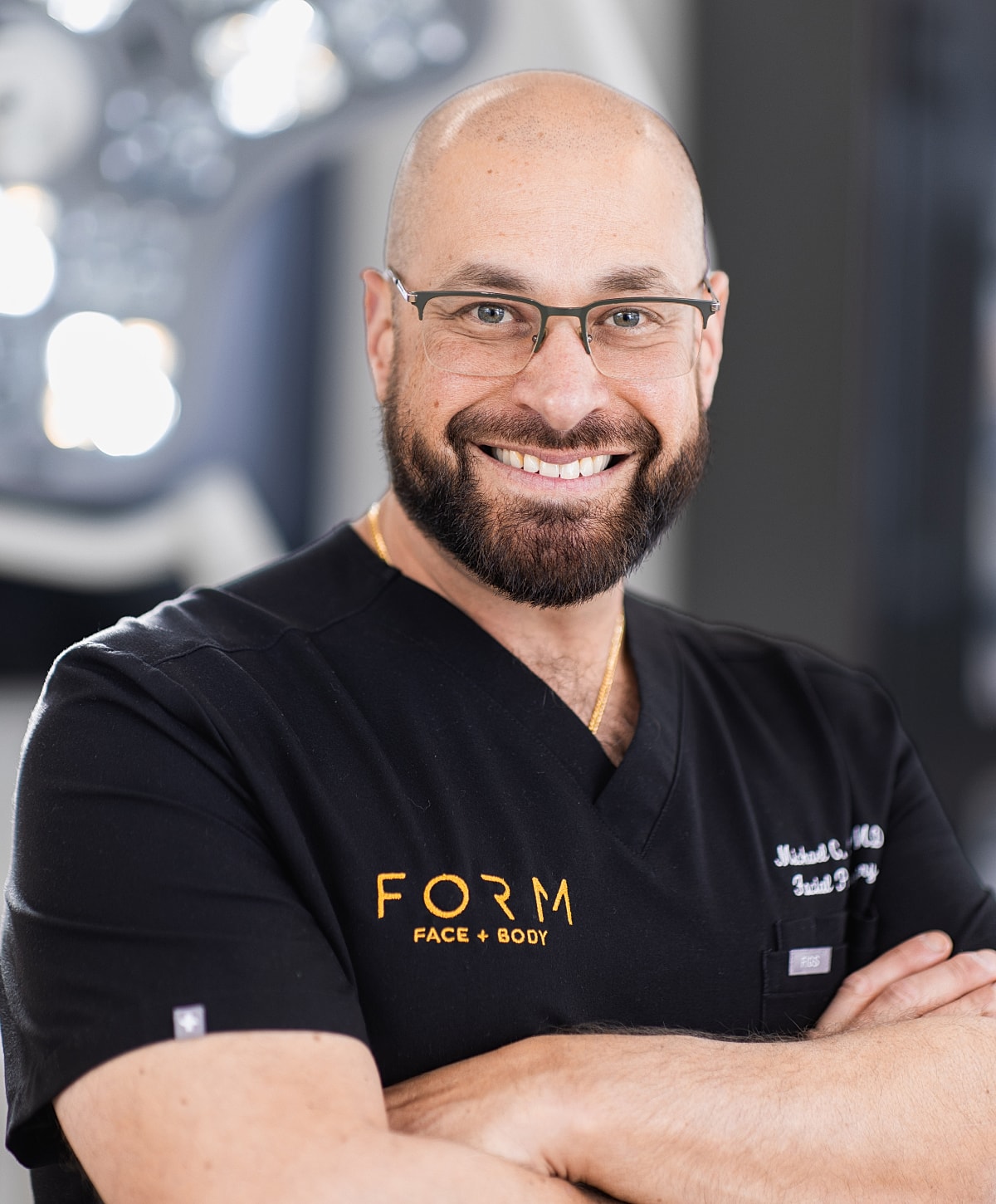
Dr. Michael Brandt is a Royal College-certified Otolaryngology – Head and Neck Surgeon specializing in facial plastic and reconstructive surgery. He is fellowship-trained in facial plastic surgery and serves as an Assistant Professor at the University of Toronto, where he contributes to surgical education and research.