Published
11 minute read
“Do you do a deep plane facelift?”
It has become one of the most common questions patients ask me.
A few years ago, the same patient might have asked about a “mini facelift.” Before that, it might have been a “SMAS lift.”
Facelift terminology changes. Anatomy doesn't.
And that is the first thing I want patients to understand.
There isn't one facelift operation that is right for everybody. A good facelift should be chosen based on what has actually changed in your face, what you want corrected, how much surgery you are comfortable with and what risks you are willing to accept.
At FORM Face + Body in Toronto, I don't start by deciding which branded facelift I want to perform.
I start with the patient.
Even the word facelift is a little misleading.
Most modern facelifts are primarily designed to improve aging in the lower face and the neck. Depending on the technique, they may also reposition part of the cheek or midface.
They usually do not automatically include the upper third of the face.
A facelift does not usually lift your forehead.
It does not necessarily raise your eyebrows.
It does not remove upper-eyelid skin.
Those problems may require a brow lift, upper blepharoplasty or another separate treatment.
So when someone advertises a “full facelift,” I think patients should ask what that actually includes.
The name alone doesn't tell you.
The earliest facelifts were relatively simple.
Surgeons lifted the skin, removed some excess and pulled the skin tighter.
That made sense when our understanding of facial aging was mostly focused on loose skin.
The problem is that the face doesn't age only at the skin level.
The deeper soft tissues descend as well.
Fat shifts.
Support structures loosen.
The jawline changes.
The neck changes.
If the entire correction depends mainly on pulling the skin, the skin has to carry too much tension. That can contribute to short-lived correction, widened scars and the pulled or overly tight appearance people understandably fear.
Modern facelift surgery evolved because surgeons realized we needed to treat deeper support tissues, not just the skin. [1]
You will hear this term repeatedly when researching facelifts.
SMAS stands for the superficial musculoaponeurotic system.
Don’t worry, there won’t be a test. You don't need to remember the name.
Think of it as a strong layer of tissue beneath the skin that is connected to the facial muscles and soft tissues.
In the 1970s, surgeons began paying much more attention to this deeper layer. The SMAS was formally described anatomically by Mitz and Peyronie in 1976, and modern facelift surgery increasingly shifted away from relying on skin tension alone. [1]
That was a major advance.
Instead of asking the skin to hold everything up, surgeons could reposition the deeper tissues and then allow the skin to lie naturally over the new shape.
That basic principle is still central to good facelift surgery today.
A SMAS plication is one of the established ways of repositioning the deeper tissues.
Rather than extensively dissecting underneath the SMAS, the surgeon folds or tightens this layer with sutures.
That may sound less fashionable today because deep plane facelifts receive much more attention on social media.
But SMAS plication isn't an outdated operation.
It has been used successfully for decades.
In fact, systematic reviews continue to identify SMAS plication as one of the most commonly used facelift techniques, with high patient satisfaction across modern SMAS approaches. [2]
A well-performed plication lift can provide excellent correction of the jawline, jowls and lower face.
It can also offer some practical advantages in selected patients because the deeper dissection is more limited.
The key phrase is selected patients.
Not every face requires the same amount of release and movement.
Sometimes you don't need to take the entire house apart to move the furniture.
The deep plane facelift was described by surgeon Sam Hamra in 1990. [3]
Instead of primarily tightening the SMAS from above, the surgeon enters a deeper surgical plane and releases some of the ligaments that hold the facial tissues in place.
This allows the skin, fat and deeper supporting layer to move together as a unit.
The potential advantage is greater movement of descended tissue, particularly in patients who have meaningful cheek descent, jowling and changes around the nasolabial fold.
It also allows the surgeon to place much of the lifting tension in the deeper tissues rather than on the skin.
For the right patient, it can be an excellent operation.
I perform deep plane techniques when the anatomy and goals justify them.
But that doesn't mean every patient needs a deep plane facelift.
This is where the marketing gets ahead of the science.
There is now good evidence that deep plane facelifts can produce excellent results with high patient satisfaction.
There is also good evidence that modern SMAS facelifts work very well.
Recent systematic reviews comparing the two approaches have not established one technique as universally superior. Both can provide strong, durable results, and the available studies are too different from one another to declare a single winner. [4,5]
One recent systematic review of SMAS techniques specifically concluded that deep-plane approaches have not yet been shown to produce clearly better longevity than other well-performed SMAS techniques. [5]
That is important.
Deep plane surgery is not magic.
It is an anatomical approach.
The terminology has become even more confusing because there are now many variations.
Deep plane.
Extended deep plane.
Vertical deep plane.
Limited-delamination deep plane.
Short-scar deep plane.
Surgeons have modified the operation in different ways to change how far the tissues are released, which ligaments are addressed, how the neck is treated and where the tissues are repositioned.
These modifications can be useful.
But they also reinforce a larger point:
Even “deep plane facelift” does not describe one identical operation performed by every surgeon.
The details matter more than the label.
This may be the least useful term of all.
There is no single standardized operation called a mini facelift.
One surgeon's mini facelift may involve a short incision and skin tightening.
Another may perform SMAS plication.
Another may perform a short-scar deep plane dissection.
There are legitimate smaller operations, including techniques such as the MACS lift and other short-incision facelifts, that can work very well in appropriately selected patients. [6]
But “mini facelift” itself does not tell me enough about what was actually done.
It is largely a descriptive or marketing term.
And there is another issue.
Patients sometimes hear “mini” and assume it means:
mini scar, mini recovery, mini risk, but full facelift result.
That isn't necessarily true.
A smaller operation usually treats a smaller problem.
If someone has mild early jowling and minimal neck laxity, that may be entirely appropriate.
If they have significant facial descent and an aging neck, doing less surgery simply because it is called “mini” may also produce less correction.
There is no prize for performing the smallest operation.
There is also no prize for performing the biggest one.
The goal is to perform the right operation.
This is another area where terminology causes confusion.
A facelift and a neck lift are closely related, but they are not always the same thing.
Some patients mainly need their jawline improved.
Others have significant neck skin laxity.
Some have platysmal bands.
Some have excess fat under the chin.
Others have deeper structures contributing to neck fullness.
A facelift incision may allow us to treat some of these problems, but the degree of neck surgery can vary substantially.
More aggressive deep-neck procedures have also become popular, including treatment of deeper fat, muscles and sometimes the submandibular glands.
These can be useful in selected patients, but they also add another level of surgery and potential risk.
Again, more extensive does not automatically mean better.
This deserves to be said again because patients understandably assume otherwise.
A facelift generally does not mean your entire face is being lifted.
If your main concern is heavy upper eyelids, the solution may be an upper blepharoplasty.
If the eyebrow itself has significantly descended, a brow lift may be appropriate.
If your concern is forehead lines, a facelift isn't the treatment for that either.
I don't automatically add a brow lift because someone is having a facelift.
Just as with the lower face, we treat the anatomy that actually needs treatment.
Sometimes that means combining procedures.
Sometimes it means leaving the upper face alone.
Not choosing the most fashionable technique.
A natural result comes from repositioning tissues in a way that respects the patient's anatomy.
It comes from avoiding excessive skin tension.
It comes from preserving normal facial shape.
And it comes from knowing when enough is enough.
The goal should not be to make a 60-year-old look 35.
The goal is usually to make that person look like a better-rested, less descended version of themselves.
You should still look like you.
I think about three things.
Where is the aging actually occurring? Is the main problem jowling? Neck laxity? Cheek descent? Skin? Deeper tissue? Usually it is a combination.
Some patients want a meaningful change and are comfortable with more extensive surgery.
Others want a smaller improvement and prioritize recovery.
Neither is wrong.
Every additional layer of surgery has a purpose, but it also has a trade-off.
A more limited SMAS plication may be completely appropriate for one patient.
Another may benefit from a deeper release.
A third may need significant neck work.
And someone with relatively little facial descent may not need a facelift at all.
That is why I don't believe the consultation should begin with:
“Which facelift are you selling?”
It should begin with:
“What has changed in my face, and what is the safest operation that will accomplish what I want?”
Facelift surgery has evolved enormously.
We moved from skin-only operations to deeper SMAS techniques.
Plication lifts have been used successfully for decades.
Deep plane surgery added another powerful way of releasing and repositioning descended facial tissues.
And surgeons continue to modify all of these operations.
But the evolution of facelift surgery has not produced one operation that is best for every face.
At FORM Face + Body in Toronto, we choose the operation based on the patient rather than trying to fit every patient into one technique.
Sometimes that means a plication-based lift.
Sometimes it means a deep plane approach.
Sometimes the upper face needs a separate operation.
And sometimes the right answer is that you aren't ready for surgery yet.
The name of the facelift matters less than whether the operation matches your anatomy, your goals and the amount of surgery you are comfortable having.
That's the conversation I think patients should be having.
A facelift is a surgical procedure with potential risks including bleeding, infection, scarring, skin-healing problems, temporary or permanent nerve injury and the need for revision. The appropriate technique depends on individual anatomy, health and goals. This article is educational and is not a substitute for an individual surgical consultation.
written by
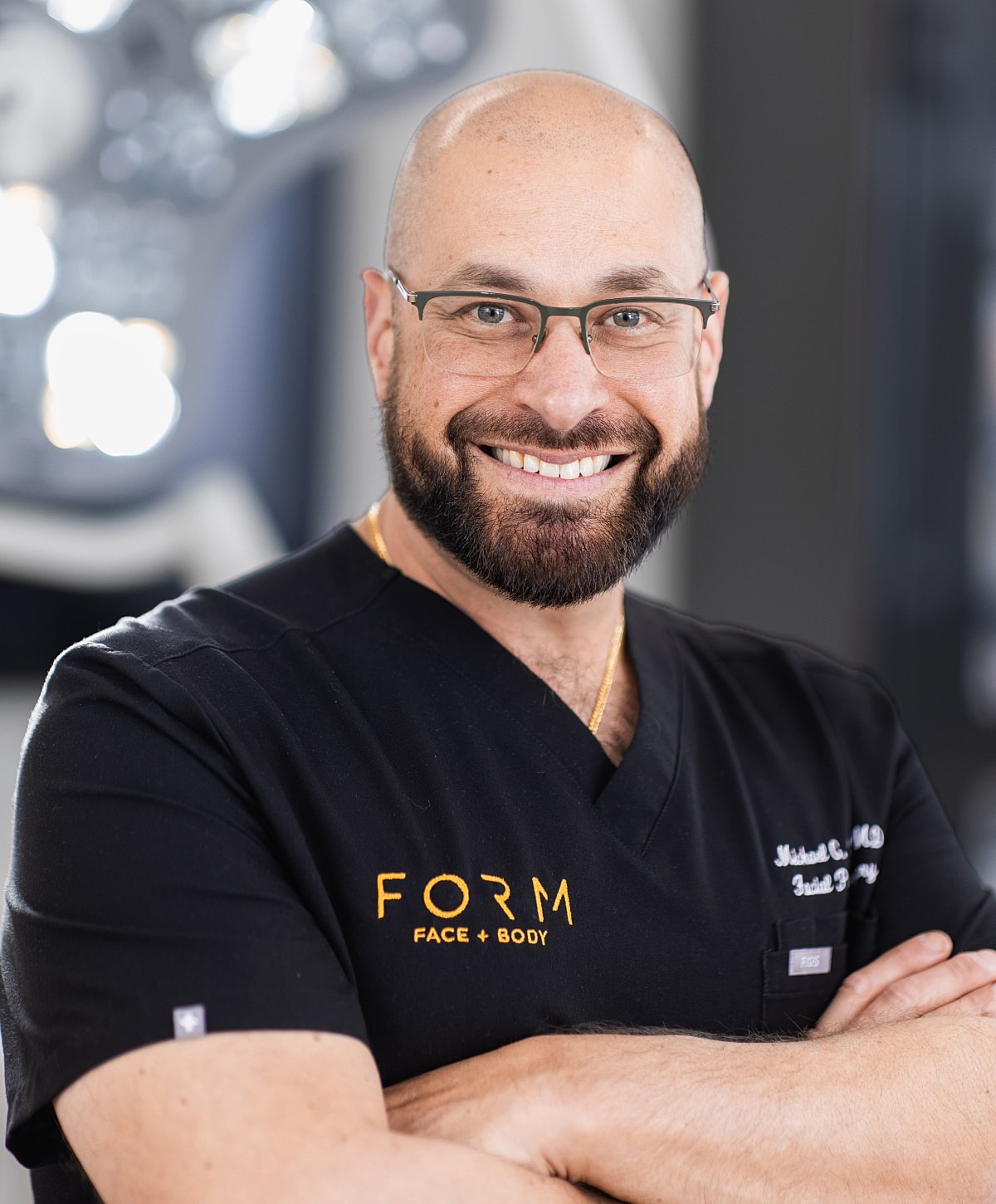
Dr. Michael Brandt is a Royal College-certified Otolaryngology – Head and Neck Surgeon specializing in facial plastic and reconstructive surgery. He is fellowship-trained in facial plastic surgery and serves as an Assistant Professor at the University of Toronto, where he contributes to surgical education and research.