Published
14 minute read
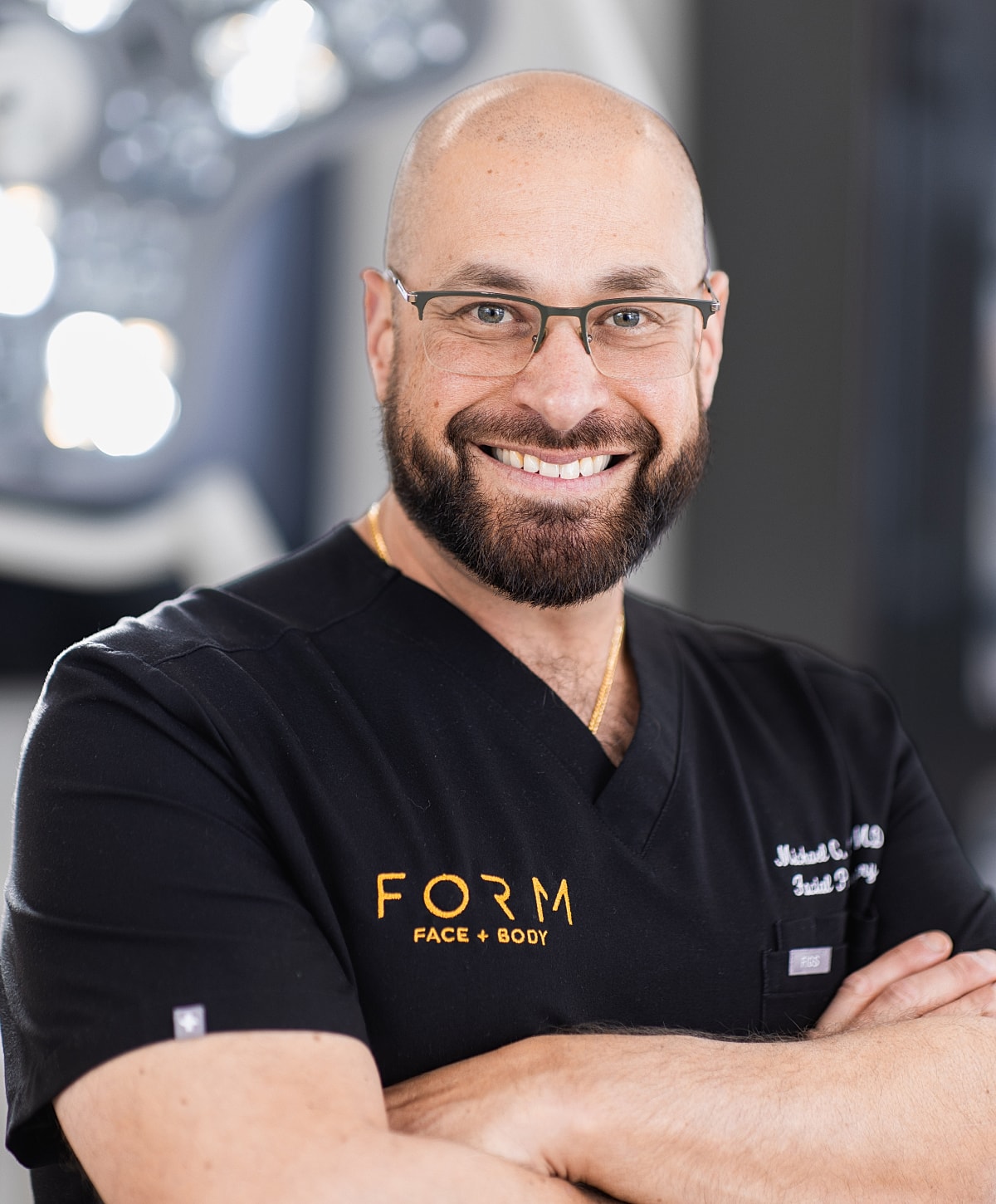
By Dr. Michael Brandt, MD, MSc, EMBA, FRCSC, Otolaryngology Head and Neck Surgeon, FORM Face + Body, Toronto
One of my biggest frustrations in aesthetic medicine is the phrase "liquid facelift." It suggests that injecting filler and performing a facelift are two different ways of accomplishing the same thing.
They aren't.
Fillers restore or add volume. A facelift repositions descended facial tissues. Filler can soften shadows and change the contours of the face, sometimes creating the illusion of a lift. But it does not release, reposition and resuspend the deeper facial tissues the way surgery does.
That distinction matters. If your face has lost volume, filler may be an excellent option. If your cheeks have descended, your jowls have become prominent or your neck is sagging, repeatedly adding volume may make you look fuller without making you look more youthful.
As a facial plastic and reconstructive surgeon who also performs injectable treatments, I don't see fillers and facelifts as competing products. They're different tools for different problems, and sometimes the best result comes from using both—for the right reasons.
As we age, the face changes in several ways at once. We lose some of the fat and structural support that give the face its shape. The skin gradually becomes less elastic. At the same time, the deeper soft tissues can descend, changing the cheek, jawline and neck.
Volume loss and tissue descent often occur together, but they are not interchangeable.
Consider two patients who both feel that their faces look tired. One has hollow temples, flatter cheeks and less fullness around the mouth, but a reasonably well-defined jawline. Another has relatively full cheeks, yet the lower face has become heavier, with visible jowls and loose neck skin.
It would be a mistake to give both patients the same treatment. The first may benefit from carefully placed volume. The second has a tissue-position problem, not simply a shortage of filler.
Hyaluronic acid fillers can replace volume, restore contour and soften transitions between facial regions. Used thoughtfully, they can improve a hollow temple, a flattened cheek, a recessed chin, or a depression beside the mouth or jawline. They can also be useful for selected post-surgical refinements.
This is where fillers are at their best: restoring something that is missing, or adjusting a small contour deficiency. The American Society of Plastic Surgeons describes fillers as treatments for facial fullness and contour, not as substitutes for surgery when significant sagging is present.
The fact that filler can change someone's appearance dramatically does not mean it has performed a facelift. It has changed the three-dimensional shape of the face by adding material.
I hear about "lifting with filler" at conferences and in the medical aesthetics literature. It is one of my pet peeves because the word lift implies something more substantial than what filler reliably accomplishes.
When surgeons talk about lifting the face, we're talking about mobilizing deeper tissues, moving them to a more youthful position and securing them there. A filler injection does not perform that operation. It doesn't release the retaining ligaments, mobilize the SMAS or resuspend descended cheek and jawline tissues.
Filler can create projection, smooth a shadow and alter how light falls across the face. Some studies have also measured small changes in skin-surface position after injections. That is a real observation, but it should not be confused with surgical repositioning.
A 2026 critical review of the filler literature made this very point: studies use "lift" to describe a range of different outcomes, from changes in surface contour to actual tissue displacement, without a consistent definition. Earlier cadaver research measured small surface displacements after strategically placed injections. Neither establishes that filler reproduces the deep structural changes achieved by a facelift.
My position is simple. If I am adding volume, I will call it volume restoration. If the goal is to lift substantially descended tissues and hold them in a new position, that requires surgery.
A modern facelift is not just pulling the skin tighter. Depending on the patient's anatomy and the technique selected, it involves repositioning and supporting the deeper tissues of the lower face, improving jowls and redefining the jawline. Neck-lift techniques can address accompanying changes in the neck.
Those are mechanical changes. We are moving tissue, not hiding its new position by adding volume around it.
This is why a facelift can make a pronounced jowl look substantially better without adding bulk to the lower face. It also explains why a facelift may not fix every concern about facial ageing. Repositioning tissue does not automatically replace volume lost from the temples, cheeks or other areas.
The American Society of Plastic Surgeons recognizes this distinction and notes that fillers or fat transfer may complement surgery when volume loss is part of the picture.
I don't choose a facelift technique because it has the most fashionable name. I choose an approach based on the patient's anatomy, degree of descent, neck changes, health and goals. The important part is addressing the problem that's actually there.
This is the trap I most want patients to avoid.
A little strategically placed filler can soften a depression in front of a jowl or improve a genuinely underdeveloped chin. But when the lower face is already heavy, adding volume around descended tissues can make the face wider, rounder or more crowded.
You may camouflage the jowl from one angle while making the entire lower face look heavier from another. The same can happen when someone keeps adding cheek filler in an effort to counteract tissue descent. Eventually, the volume itself may become more noticeable than the original ageing change.
Another issue is that filler doesn't always disappear on the timetable patients have been given. A small 2024 magnetic resonance imaging study detected residual hyaluronic acid filler in patients years after their last treatment, sometimes much longer than expected. That doesn't mean everyone's filler will remain for years, but it challenges the assumption that each new injection starts with a completely empty canvas.
This is one reason I assess the whole face, including previous treatments, before recommending more product. Sometimes what looks like worsening ageing is partly excess or misplaced volume.
And sometimes the best filler treatment is no filler at all.
There isn't a magic birthday or a fixed number of syringes that tells you it's time for surgery. I pay more attention to the anatomy and the result the patient wants.
If your main concern is hollowing, and the tissues are otherwise well positioned, there may be no reason to consider a facelift. If your main concern is jowling, a heavy lower face, loss of jawline definition or neck laxity, the conversation changes.
Other signs that filler may no longer be the right strategy include needing progressively more product to achieve less noticeable improvement, looking puffier without looking more rested, or repeatedly trying to camouflage the same sagging tissue.
That doesn't mean you must have surgery. A patient may prefer a smaller improvement and no operative recovery. That's a reasonable decision, as long as we are clear about the limitations.
But if your goal is a meaningful lift of descended tissues, I would rather tell you that surgery is the appropriate treatment than keep selling you something that cannot do the job.
Previous filler does not automatically prevent someone from having a facelift, and I don't believe every patient needs to dissolve all their filler before surgery.
However, the history matters. Residual filler, inflammation, nodules or changes in tissue planes can affect surgical assessment and planning in selected patients. A published survey of facelift surgeons found that just over half of respondents believed repeated panfacial filler use made facelifts more difficult. That was a low-response survey of surgeon opinions, not a controlled study proving that filler causes complications.
Before surgery, I want to know which products were used, where they were placed and when they were injected. If existing filler is distorting the contours or interfering with an accurate assessment, targeted dissolution of hyaluronic acid filler may be worth considering. It isn't something I recommend automatically for everyone.
The point isn't that filler ruins future surgery. It's that every treatment should make sense in the context of the patient's longer-term facial plan.
This is where the conversation becomes more interesting. Fillers and facelifts are not interchangeable, but they can be complementary.
A facelift can reposition the tissues responsible for jowls and lower-face laxity. It doesn't necessarily replace the volume that has been lost with age. Once we've restored the position of the tissues, we may still want to improve fullness in a hollow cheek, temple or another specific area.
One option is fat grafting. During or around a facelift, a surgeon may transfer a patient's own fat into areas of volume deficiency. Studies have shown that combining fat grafting with a facelift can improve facial volume and overall rejuvenation.
But fat grafting has an important limitation: not all the transferred fat survives. The proportion retained varies considerably by patient, anatomical area, surgical technique and how it is measured. A systematic review of 27 studies involving 1,011 patients found reported facial fat-graft volume retention ranging from 26% to 83%, with an overall pooled estimate of approximately 47%.
That does not mean every patient loses half their fat. It means the final volume can be difficult to predict precisely.
Once someone has healed from surgery and the volume has stabilized, carefully placed filler may help fine-tune a small remaining deficit. For example, if one cheek retains less grafted fat than expected, filler may offer a measured adjustment without repeating an entire fat-transfer procedure.
It is important to be precise about what that accomplishes. Filler does not make transplanted fat survive better. It can compensate for residual volume loss when fat-graft retention has been incomplete or uneven.
Published surgical experience supports this approach. A retrospective series described the use of poly-L-lactic acid after facelift and fat grafting to manage persistent or recurrent volume deficiencies. Hyaluronic acid fillers may also be used for more localized refinements. The choice depends on the area, desired result, product characteristics and risks—not on a belief that every post-facelift patient needs filler.
I prefer to let healing settle before judging what additional volume, if any, is necessary. An early postoperative contour is not the final result, and rushing into more injections can lead to overcorrection.
This is the role I want filler to play: complementing a properly selected operation rather than trying to replace one.
They involve different risks, so the comparison isn't simply "injections are safe and surgery is risky."
Hyaluronic acid filler injections can cause swelling, bruising, lumps, delayed inflammation or unwanted volume. Rarely, injection into a blood vessel can cause skin injury, blindness or stroke. The ability to dissolve hyaluronic acid with hyaluronidase is useful, but it cannot reliably reverse every complication.
Facelift surgery involves anaesthesia or sedation, incisions, recovery time and surgical risks that can include bleeding, infection, skin-healing problems, scarring and nerve injury.
The choice should be based on which treatment addresses the patient's anatomy, how much improvement is realistically achievable and whether the benefits justify the risks. Repeatedly performing the wrong procedure because it sounds less invasive is not automatically the safer or more economical strategy.
No. Filler can restore volume, alter contour and create the appearance of greater support, but it cannot surgically reposition and secure significantly descended facial tissues. If you need a substantial lift, a facelift is the more effective treatment.
It may change how the cheek and jawline look, and a small contour adjustment can sometimes soften an irregularity. But adding filler to a heavy lower face can also make it look fuller. It does not correct the underlying descent responsible for significant jowling.
Not automatically. I assess the type, amount and location of existing filler and whether it is affecting facial contours or surgical planning. Some patients may benefit from selective dissolution; others do not need it.
Yes. In selected patients, filler can help address a small remaining or later-developing volume deficiency once surgical healing has stabilized. The goal is refinement, not replacing the lift accomplished by surgery.
They serve overlapping but different roles. Fat grafting uses the patient's own tissue and can be integrated into a surgical plan, but its retention is variable. Filler can provide targeted correction without another grafting operation, although it brings its own longevity and safety considerations. Neither is required for everyone.
You don't have to have it. We can discuss what can realistically be achieved with fillers or other non-surgical treatments. The important thing is not to confuse a modest improvement in shape with a true repositioning of descended tissue.
I like fillers. Used thoughtfully, they're exceptionally useful for restoring facial volume, refining contours and complementing surgical results.
What I don't like is pretending that adding volume and lifting the face are the same thing.
If you're hollow, we can talk about restoring volume. If your tissues have descended and you want them moved back into position, we need to discuss a facelift. And if you have both problems, the most natural result may come from addressing both—with surgery for tissue position and selective volume restoration where it's actually needed.
At FORM Face + Body in Toronto, I offer both surgical and non-surgical facial rejuvenation. That allows me to focus on your anatomy and goals instead of trying to fit you into a particular treatment.
If you're wondering whether another round of filler will help, or whether it's time to consider a facelift, I invite you to come in for a consultation. We'll look at what has changed, what's already been treated and what is most likely to give you a result that looks natural and still looks like you.
https://www.plasticsurgery.org/cosmetic-procedures/dermal-fillers https://pubmed.ncbi.nlm.nih.gov/42620772/ https://pubmed.ncbi.nlm.nih.gov/33890889/ https://www.plasticsurgery.org/cosmetic-procedures/facelift https://pubmed.ncbi.nlm.nih.gov/39015357/ https://pubmed.ncbi.nlm.nih.gov/36860684/ https://pubmed.ncbi.nlm.nih.gov/31907534/ https://pubmed.ncbi.nlm.nih.gov/31940073/ https://academic.oup.com/asjopenforum/article/doi/10.1093/asjof/ojac014/6542251 https://www.fda.gov/medical-devices/aesthetic-cosmetic-devices/dermal-fillers-soft-tissue-fillers
written by
Dr. Michael Brandt is a Royal College-certified Otolaryngology – Head and Neck Surgeon specializing in facial plastic and reconstructive surgery. He is fellowship-trained in facial plastic surgery and serves as an Assistant Professor at the University of Toronto, where he contributes to surgical education and research.